Showing posts with label TV. Show all posts

Wednesday, December 29, 2010

Wendy's Films of 2010 # 111 - #134: A Rush to Finish 2010's Reviews!

What with the store closing and all, I decided to take a slightly unconventional turn in an attempt to finish reviewing every new film (new to me, that is) I watched this year. I knew I wouldn't make it writing longer reviews since I have over 60 movies left on the list, but thought that this might at least be fun to read even if it wasn't very descriptive.

My guilty pleasure. Sexy, southern and full of bloodlust; it's like eating a dark, rich dangerously delicious chocolate cake that I just can't get enough of.

Jackie Chan a school janitor? You bet, but as expected he's soon to become a kick-ass martial artist! Good, but not the best Chan movie I've seen.

#113. Batman: The Movie (1966)
"Some days you just can't get rid of a bomb." Cheesy, corny, wonderful 1960s fun: "It looks bad, batman. This brassy bird has us buffaloed."

#114. Lifeforce (1985)
A crazy sci-fi, vampire, zombie movie that's bound to blow your mind with it's absurdity, badness and greatness.

#115. Princess Mononoke (1997)
Probably my favourite Hayao Miyazaki film so far. The music, the animation, the colours, and especially the story: everything just blew me away.

#116. Subway (1985)
A neat film directed by Luc Besson and starring a french-speaking Christopher Lambert who roams the subways of Paris while blackmailing the woman he's infatuated with. It's very 80s and kind of strange, but awesome.

Really? You need a review? Nah.

#118. Delicatessen (1991)
Colourful, classic Jean-Pierre Jeunet full of funny, sweet, dark and strange moments that are sure to please (if you're like me, that is.)

#119. Super Mario Bros. (1993)
I have no idea how they came up with the ideas they used in this film, but it's pretty fucking crazy and I kinda liked it.

#120. The Ladykillers (2004)
I really enjoyed this one, though that trend is pretty common with
me and the Coens. I'm still not totally sold on Tom Hanks, but hey, he's not so bad.

#121. Twilight: Eclipse (2010)
Unfortunately, it was better than the first.

#122. The Awful Truth (1937)
I love my Cary Grant romances and this is another classic. Perhaps not as wonderful as some of his others, but it seems he really can't go wrong.

#123. Project A-2 (1987)
"But I'm not cooking! So it stays open!" Apparently I thought this Jackie Chan line was so terribly funny that it deserved to be quoted, but I can't for the life of me remember why. I can't even remember what the movie's about. I think he plays a straight cop in a crooked area of town or something...

Crazy disgusting slimy ear bugs. Also, it's quite awesome.

Colourful, nonsensical, neat to watch and Heath Ledger's last film.

#126. Objectified (2009)
Ooo, this documentary was way more boring than I thought it would be. I fell asleep.

#127. Porco Rosso (1992)
Wonderfully detailed, beautifully animated Miyazaki film about a mysterious swine-resembling pilot that takes a begrudging liking to a young girl and the antics that ensue.

Charming in a 1950s musical kind of way. Not my favourite old musical, but it'll do.

A lovely film by Agnes Varda about the life she lead, the man she loved and the beautiful films she made.

#130. Freaks and Geeks (1999-2000)
Probably my favourite series of the year (either that or Skins). It's a great, funny, interesting show about high school in the early 80s and I just can't get its lead, Linda Cardellini, out of my head. (Also starring James Franco, Seth Rogan, Jason Segal and directed by Judd Apatow. I know, right?)

#131. The Jerk (1979)
A charming idiot (Steve Martin) somehow ends up alright after leaving his family

#132. Against All Flags (1952)
Errol Flynn. Pirates.

#133. Super Fly (1972)
Pretty good blaxploitation film about a man who wants out of the cocaine dealing business: "Can you dig it?"

#134. Undeclared (2001-2002)
Sort of a continuation of Freaks and Geeks, directed by Apatow, but starring a completely different cast and taking place a few decades later. Also, not quite as good.

Thursday, November 11, 2010

Ryan Watches A Motion Picture #81: Blue Planet (2001)


This BBC series apparently five years in the making is narrated by none other than the nature doc legend himself, David Attenborough. His wisened voice has lent itself well to the nature documentary for some time, and does no disservice to the sea. If you haven't treated yourself to a lengthy and thoroughly entertaining series like this yet, you better get on that while there are still animals in the ocean to appreciate.

As you'd expect, you'll be given stunning footage of the intricacies of undersea life, running through the various kinds of sea environments that the world has to offer. You'll be given footage and information that might even turn off the squeamish - nature, children's stories tell us, isn't exactly nice, or unfalteringly pretty. Easy to forget, but the series will offer up some firm reminders that majesty is a thing of power, and power is very often a thing of violence. When you're not seeing amazing beauty, you might be seeing killer whales play tennis with a baby seal, or the eggy, undulating jangly bits of lobsters ready to give birth.

So: Awesome. An emotional roller coaster at times, but in the healthiest way.

Thursday, October 21, 2010

Ryan Watches A Motion Picture #74: Babylon 5 - Season 1 (1994)

I'm sure some of you know this series well. It's a TV series that's held in pretty high esteem by a great many, myself included.

This review will be for two sorts of people. One is the sort that has seen some of the first season and said to themselves "this is a piece of shit and I hate your guts J. Michael Straczynski" and stopped watching. The other is the sort that say to themselves, every year or so, "I should probably get around to watching that crazy Babylonia 18 show that my nerd friends talk about too often."

The concept is this: Babylon 5 is earth's greatest achievement - a massive space station in distant and neutral space built to function as a centre of commerce and diplomacy between the various alien races of the galaxy. Lots of politics, fantastic character drama, and, about 2 seasons in, grand and poetic space opera of the best kind. Probably 70 percent of the series was written all at once as what creator Straczynski calls a telenovel, and benefits greatly from having had a start and finish already intricately planned by the time the pilot hit the airwaves.

Babylon 5 tries very hard not to be Star Trek, and does pretty damn well in its goal. B5 isn't afraid to give you alien races that are much more alien than your average Trek alien. Communication between alien cultures is often very strained. There's a large mantis-like insect that's top gangster in the shady areas of the station, and a tentacle-faced Cthulu-type alien that only eats decaying food because they evolved from a scavenging animal. In general, the skull shapes and faces of the alien races are a bit more varied than you're used to in other shows.

This doesn't always make for a good first impression however. You have to get over your initial knee-jerk this-is-not-like-startrek reaction and adapt to the different flavour. Star Trek has had a monopoly on sci fi television for so long that any series that isn't Star Trek wears its invisible shackles. If you had caught any episodes of the series during its run in the 90s, you probably saw a dude with hair like a paper fan and changed the channel. On its surface, and because of season 1's terrible budget, the show can look pretty silly at times. The CGI stuff didn't look good, and the sets looked dreadfully cheap. Michael O'Hare's lead act as Captain Sinclair is embarrassing, and he manages to ruin almost every scene that reaches for emotional force. Once he leaves in season 2, the series takes a serious upturn. So season 1 is pretty terrible, but there's enough important information and character set-up that unfortunately makes it necessary to watch. Now and again you'll get a winning episode, one that hints at the bigger picture to come in later seasons, but for the most part season 1 is comprised of forgettable little one-offs.

So: Placing the 'recommended' tag on this review was a strange decision, but for the awesomeness of what is to come, it must be so written. And the fan hair will grow on you once you realise how fucking awesome Londo Mollari is.

Tuesday, July 13, 2010

Pose Reviews A...TV Show?! #23: Buffy The Vampire Slayer (Season One)

Despite being among the target demographic for Buffy The Vampire Slayer while it was actually on television, it took me till now to actually sit down and watch it.

And both to my surprise, and the surprise of die-hard Buffy fans who tend to think the first season is sheer swill, and explain it away with a desperate "it gets better after this," I actually dug it!

Yep, it's safe to say that I've been bitten by the Buffy bug. And given that it's only a bug and not some larger, more sinister creature of the night, I think I got off light.

There are three things that make Buffy so enjoyable, in this converted cynic's opinion...

First, it doesn't take itself too seriously.

Most of the time.

There are certainly instances of melodrama in the first season, but they're usually offset by corny and occasionally self-reflexive one-liners, and charming humour that may inspire more "aww's" than guffaws, but still work to keep the show lighthearted.

It also helps that, despite its outlandish premise, the plot of Buffy manages to covers its bases.

Although some of the explanations for the weird and wonderful phenomena that occur on the show are a little thin, they're there, and if you can suspend your disbelief, you can enjoy the hell out of some of the more ridiculous episodes. (No pun intended.)

Secondly? The characters on Buffy are just so freakin' endearing.

I didn't realize Buffy was a kind of paranormal-themed Freaks and Geeks, but lo and behold, the elements are there!

Buffy herself has trouble leading a normal teenager's life of listening to awful music and sulking, given that she's responsible for guarding humanity against the forces of evil.

And her friends, the adorably awkward Willow (played by American Pie's and How I Met Your Mother's Alyson Hannigan) and the delightfully sarcastic Xander (played by Nicholas Brendon, who isn't really famous but looks like the guy from Boy Meets World) are going through their own growin' pains--more social than biological, but pains nonetheless. (Oh, and occasionally they get punched. Hard. Which I guess just qualifies as "pains" without the "growin'".)

And thirdly? Season One has vintage cred. HARDCORE vintage cred.

Remember, it's from 1997, so some of the episodes make really awesome, outdated references.

Especially the episode where a demon haunts the internet.

Oh yes.

And keep in mind, this is the internet circa 1997, so there are frequent references to floppy disks and modems, made in total seriousness given that they were the height of technological achievement at the time.

And it's hilarious.

All in all, season one of Buffy The Vampire Slayer is cute, campy and thoroughly enjoyable--plus, it gears you up for six more seasons which I've heard get pretty spectacular.

I'd definitely recommend it as a fun twelve hours of entertainment, not to mention a great throwback to the nineties.

Oh yeah, and there's also vampires.

Friday, May 28, 2010

Ryan Watches a Motion Picture #33: Kröd Mändoon and the Flaming Sword of Fire - Season 1 (2009)


For a fantasy junkie such as myself, the prospect of a heroic fantasy-inspired TV comedy is very, very enticing. So enticing that I've been working on my own web series for about two years. Here's a shameless plug. I thought I might have been the first to offer such a thing to people, but it turns out that at the exact same time, in some dank Comedy Central dungeon, a show entitled Kröd Mändoon and the Flaming Sword of Fire was being produced, which, jealousy aside, only manages, sadly, to hit the 'OK' mark.

While there are some good and clever gags, the show's humour relies far too much on penis jokes and homophobia. Sometimes both hitting you at once for a dual-tech of stupid. There's also a lot of the show's sole female character showing skin and having frequent sex. The show is very clearly written by men, and, more importantly, men into the kind of male wish fulfillment you can find in the most boring fantasy writing. The characters on a whole aren't terribly likable, save for the bad guys. Indeed, the most entertaining stuff is found when you can watch the fickle and evil Chancellor Dongalor (chancellor's always seem to be evil) and his painfully more competent and wonderfully polite attendant Barnabus. They're a real treat, and in Dongalor the series eventually comes to present a character that calls for some genuine emotional investment. So kudos to the writing there.

So: I suspect that as the series goes on and the writers abandon their more basic strategies for the stuff that really works best it'll really become something worth watching.

Saturday, April 3, 2010

Wendy's "Films" of 2010 #59: How I Met Your Mother, Season 1 (2005)

Nearly everyone I know has been blabbering on about How I Met Your Mother for about the past four years, and I never really wanted to hop on the bandwagon. So, until now, I avoided it, but decided recently that I should see what all these people are crapping their pants over. It's pretty good! Not excellent, but there are certainly moments of sheer amusement. I would watch the second season, maybe not next week, but perhaps this year. Of course Neil Patrick Harris is the shining pinnacle of awesome in the show, as you've probably heard, and he definitely gets the best lines. Freeze frame high five, anyone? (That'll probably get old soon, but I'm enjoying it for the moment.) The rest of the cast is great; everyone fits in; no one is annoying, yet, though Ted is close. We'll have to see how long the rest of the series can keep up the search for Ted's future wife and still remain worth watching.

Thursday, March 25, 2010

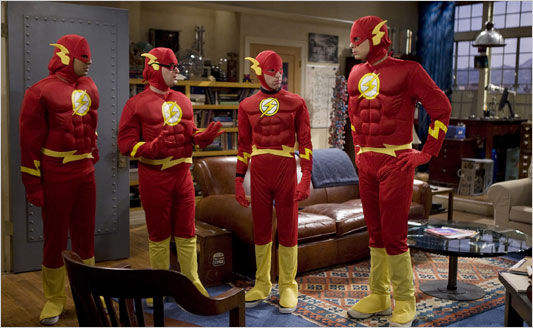
Wendy's "Films" of 2010 #54: The Big Bang Theory, Season 1 (2007)

Oh Gravity, thou art a heartless bitch.

Really I felt like ending the review there, with a delicious remark from the one and only Sheldon, the wonderfully asexual and completely socially incompetent theoretical physicist who pretty much singlehandedly makes this show worth watching. That doesn't mean the other characters aren't entertaining, but Penny and Leonard provide just the right amount of levelheadedness to make Sheldon awesome.

What makes this show funny, to me at least, is that I actually know people who are like Sheldon and Leonard. People so removed from social competence that they just become excellent: "Engineering - this is where the semi-skilled workers realize the work of better minds. Hello, Oompah-Loompahs of science" - Sheldon.

This show is infinitely quotable, a requirement for popular television comedy these days, which is good because I hope Big Bang will be around for a while. Or at least as long as it remains this entertaining.

Thursday, March 11, 2010

Wendy's "Films" of 2010 #48: Pulling, Season 1 (2006)


It took me a couple episodes to get into Pulling, a series that takes Sex and the City and turns it into a continuous series of drunken episodes filled with unfortunate incidents that usually leave Donna, Karen and Louise hungover, alone and/or bloody in the face. I kind of like it. The girls don't make up excuses, they live how they want to, accept the consequences and continue their drunken escapades. Karen, an elementary school teacher, is the most alcoholic and sexually promiscuous of the three. Louise has the most trouble attracting men, and so turns into a sort of clingy nightmare. While Donna, who recently decided not to marry her fiancé, is in a state of flux, not wanting to lose the affection of her former love, but not sure that she wants to be with him either. It's kind of a mess, but if you want to watch something that resembles an awesome trashcan version of Sex and the City, this series is for you.

Thursday, March 4, 2010

Wendy's "Films" of 2010 #43: Anthony Bourdain: No Reservations, Season 3 (2007)

Man, I really want to go to Singapore now. I almost went there before, as a sea cadet on exchange back in 2003. But then SARS happened. Like a virus, it spread, ruining my chances of seeing the faraway country I'd been dreaming of. Even better, a friend of mine was chosen to go the next year and I was sent to Fort Lewis, Washington. Basically a desert, and I was a sea cadet.

Bourdain's third season of travelling the world and eating delicious food, besides giving me cravings and a bursting desire to hop on a plane, is just as excellent as the first and second. He visits NYC, Shanghai, Brazil, French Polynesia, Hong Kong, and Singapore, among other countries and cities; he feasts on bone marrow in a food court, yak's milk cheese in the hills near Shanghai and his favourite cheap hot dog and papaya drink place around the corner from his old apartment.

Really, this show is about enjoying food and people as much as possible, and enjoying the best the place you're in has to offer. I just love how he dives in whether or not it's disgusting chili cheese spaghetti in Cleveland or a huge meal lovingly made by a new friend and eaten over an entire afternoon in São Paulo.

And apparently, Singapore has some of the best food in the world. Go figure.

Tuesday, February 16, 2010

Wendy's "Films" of 2010 #41: Skins, Season 2 (2008)

So, I obviously liked the first season of Skins. Enough to watch the second season just days after the first. It's not really ruining much to say that the cast changes after this season, as the friends finish high school and move on with their lives. I will be sad to see them go. I get attached to television characters the same way I do to those in a novel. You spend time with them, get to know them; you watch an episode here and there over a few days, or all at once, but you seem to know them better than those in a film. This season was slightly different, but the turns they took were generally for the better. There are concerns about pregnancy and other health problems. It's about growing out of your childhood and beginning to understand more serious issues, while still remaining fun and entertaining. I think I'll check out the third season when it comes out on DVD, even if almost all the characters are different. The only one remaining is Tony's younger sister Effy, whose antics in the first two seasons include overdosing on pharmaceuticals, and tricking people into making the right decisions, the ones that will make them the happiest. Should be diverting at least.

Wendy's "Films" of 2010 #39: Dollhouse, Season 1 (2009)

Why do Joss Whedon's shows always get cancelled lately? They're an awful lot more interesting and entertaining than Everybody Love Raymond, that's for sure. Dollhouse is about Caroline/Echo (Eliza Dushku), a girl who gives 5 years of her life (for an unknown reason) to a corporation that wipes the minds of young men and women and rents them out to rich customers with new minds and memories. It's interesting because you think at first that it'll be hard to connect with the characters if they keep changing personalities, but it's oddly refreshing and after a time certain characteristics begin to show through. Many characters are played by actors from past Whedon creations, and I loved several of them; Echo's handler Boyd (my friends and I came up with the term "boyded" to refer to Boyd kicking someone's ass), Dr. Claire Saunders, Echo's fellow "active" Victor, and Topher, the programmer of the mind. My one major complaint has to do with the last episode of the season, which takes a drastic turn with little to no explanation. The tone of this new style left me with very little desire to see the second season, as its characteristics aren't really aligned with my tastes. I'm trying to be a vague as possible so I don't spoil it for anyone, but I'm pleased to say that I've been told by friends that the second season returns to the original story for the most part. I definitely want to check out what happens next in this series, as Whedon draws you in with great dialogue, interesting characters and a really intriguing premise.

Wendy's "Films" of 2010 #38: Skins, Season 1 (2007)

Skins is sort of what Degrassi: The Next Generation should have been, except in the UK. Not overly dramatic, but still entertaining. It's got the drugs, the sex, the teen love; it never gets boring, but also stays away from the repetitiveness of so many recent high school TV series. The characters are likable and their lives are relatively realistic, though fun enough and outlandish enough to be worth watching. I wouldn't say it's a work of art, but it's hardly supposed to be. It's popcorn television, and it's fun. I liked Hannah Murray's spaced out, kind and wholehearted character Cassie the most, but each has their own distinct style. They're not incredibly easy to label either; I always hated that in movies and TV growing up: the preppy girl, the nerd, the jock, etc. Eugh. Can we please try not to pressure people into cultural moulds? Luckily these kids have enough development to surpass any stereotypes, and their lives are believable. Perhaps not in every aspect, but that's just part of most television.

Saturday, January 30, 2010

Wendy's "Films" of 2010 #25: Absolutely Fabulous, Season 1 (1992)

"Annoying" was the first thought to come to mind as I watched the first of six episodes, thankful that they were all under half an hour. Then I started to enjoy myself as I disregarded the shrill tone of Edina, played by Jennifer Saunders, the show's creator. At times I felt like slapping her in the face, and to my surprise and pleasure, Edina's studious daughter Saffron does just that. The only other thing that annoyed me was the laugh track; I understand that such things are hard to avoid, but it felt like someone was dictating my sense of humour to me, which I didn't appreciate. [Edit: Turns out this is actually a live studio audience, which entirely quells my displeasure :)] Then the enjoyment came, as Saffron's biting comments to her mother spewed forth as quickly as Patsy's lust for men. Patsy, Edina's best friend, fellow alcoholic and fashionista, is wonderful, with hair as high as a small watermelon, a cigarette hanging from her mouth half the time and dry humour to add to Edina's frantic half-shouting. She adds the insanely sane to this colourful and drunk series. I also enjoyed the horrible 90s fashion. I think I'll check out the next season, simply out of curiosity.

Wednesday, January 27, 2010

Ryan Watches a Motion Picture #4: The Adventure of English (2003)

It's a fascinating miniseries on the birth of the English language and its growth in time to be the global language it is today. It proves to be a detailed and stirring look at the historical forces that shaped the language and nudged it into certain patterns and dialects, and should scratch the documentary itch of any English student or lover of the word, the line, the way.

It goes over the reasons why we spell words in certain ways, how certain words have shifted meaning, and which words from our vast word-horde were trickled in from different languages as their respective nationalities clashed. How the English artists, Shakespeare among them, changed the language through their work and how they brought status to the English language abroad.

It gets a little overzealous, I think, whenever it posits that English is a particularly robust, naturally selected, or adaptable and absorbing language, since I'd guess that its spread and knack for assimilating foreign words and grammars has more to do with imperialist and economic forces rather than any kind of naturally selected flexibility, but the series does manage to admit as much near the end of the series.

So: The historical rundown it presents is compelling without need of cheesy re-enactment, and should keep you fascinated every step of the way.

*Not actually part of the documentary, but informative nonetheless.

Wednesday, January 20, 2010

Wendy's "Films" of 2010 #17: Anthony Bourdain No Reservations, Season 2 (2005)

Imagine, if you will, perfect happiness. For me this would include food, delicious food, travelling to familiar and unfamiliar places all over the world, thinking about films, watching films, friendly people and perhaps even writing. It seems Anthony Bourdain lives this seemingly impossible existence.

If only I could show you the food they eat, the way it looks, and how I imagine it smells; it would be a dream to actually be there and taste it. Don't get me wrong, I know the woes of travelling: sitting on a plane for countless hours, wading through airports, the eventual desire for familiarity. But it would be infinitely worth it just to experience what this show can only attempt (which it does very well) to express through a television.

To the right you see Bourdain gazing down at what might be his favourite meat: pork. He consumes it everywhere, Puerto Rico, Indonesia, and Seattle to name a few, the cheek is his favourite part, he says, and we hear him crunch into its skin. His biting eloquence and utter honesty when it comes to food are combined with an enthusiasm and appreciation for the generous and kind people he often meets. On top of this, his love of film is obvious, in the first season (which I watched last year), he speaks of his love of Italian Neorealism, and while in Sweden in this season he references Ingmar Bergman. Film references aside, it's a show that surpasses the conventional view we typically see of travel destinations and shows us what we really want to see: people eating everything from street food to high-end restaurant fair, but all delicious and almost all something I'd love to sink my teeth into.

Monday, January 18, 2010

Maggie's Films of 2010:

#17. Black Books, Season One


You can't watch a British comedy idly: Most require your full attention to make the best of their dry wit, and Black Books is no exception. About a reclusive bookstore owner who hates customers and cleanliness, but loves alcohol (openly) and the shop owner next door (secretly), Black Books manages masterfully with a central cast of just three characters: the aforementioned Bernard Black (Dylan Moran, series creator); the aforementioned suppressed loved interest, Fran (Tamsin Greig), and the Not Quite Right employee, Manny (Bill Bailey), who alternates between being very much together and altogether balmy. Having seen the series before, I greatly anticipated such comic escapades as The Night They Drank £7,000 of Wine and Thereafter Killed The Pope ("The Grapes of Wrath"), and... pretty much anything else in the season that involved severe liver abuse. Which, seeing as this is a British comedy, meant most of it.

#18. Shrink


Well, Spacey's back from K-PAX, that's for sure, but in what form? I never can tell with his films anymore. Nonetheless, from the get-go, Shrink defines itself clearly: This is a film where we start out with what should ostensibly feel like a dizzying number of seemingly unrelated story lines that will fuse together perfectly as time goes on. And it does! Hey! Who'd've thunk it. So from Kevin Spacey as a self-medicating celebrity psychiatrist grieving over his wife's suicide, to Robin Williams as a thinly veiled version of himself struggling with the desire for extramarital relations, to Dallas Roberts as an anal-retentive, obsessive-compulsive talent agent, to Mark Webber as a struggling screenwriter with a thing for Roberts' pregnant saint of an assistant, we're meant to be overwhelmed by the breadth of this film's reach and the depth of the issues it's addressing. But wait! I daresay we're still missing our catalyst in this whole, murky affair: young Jemma (Keke Palmer), whose deeply troubling case file is handed to Spacey by his character's father in a really unethical ploy to get Spacey past his wife's suicide. And yes, I know it's "really unethical" because my housemate's a psych grad, and for what it's worth she loved the movie for the hypothetical scenarios it allowed her to mull over in relation to her own work. As for me? The acting was decent, but the plot was far too pat. I was especially incensed by the cozy ending to a huge breach of ethics and betrayal of trust. These themes have been worked over before, elsewhere and better.

#19. World's Greatest Dad


I didn't intend to watch two back-to-back films with Robin Williams, but I can't say I minded. As a kid I watched Toys ad nauseum, and I've since always admired the breadth of roles he takes on. World's Greatest Dad belongs to a very particular role subset therein -- The Sad Man With A Smile -- and he plays it quite well here, as the middling private school teacher (Lance Clayton) with five unpublished novels and, as he later typifies it, a "douchebag" of a son. Sadly, this film reaches its zenith a third of the way through, when his son accidentally kills himself while masturbating and Lance enacts the perfect love of a father by providing a measure of dignity to the death. The trouble is, this action spirals out of hand -- going from a quiet familial moment to something that gives Lance the audience he always wanted, but at a price Lance ultimately can't bear. Oh, there were a lot of fun moments in this film, but a directorial conceit involving the school pool at the end (to push a metaphor down our throats) clinched my growing disillusionment with the script itself: Everything in this film happens because it needs to happen to fit the plot; but precious little of that follows sensibly from individual character motivations. How Lance's relationship develops with Claire (Alexie Gilmore) and ends, why he uses the precise words he does in his ultimate speech, the choices he makes with some of "his son's" writing, the way he treats his son's best friend, or his neighbour... a lot of little things make it clear Lance isn't really a character, but himself a plot device. Which is too bad, because again, the film's got a lot of fun moments. In the end, though, it tries to Mean Something -- and that's probably where it started to fall apart.

#20. The New Women


I was going to include this film in my upcoming LGBT-a-thon, but to my great surprise, this independent film from the LGBT section of our store really isn't LGBT at all. A really low-budget number about middle-aged women with run-of-the-mill marital/social problems, whose husbands all fall asleep one night and don't wake up, this film should have the makings for at least a silly romp into Bisexual-in-a-Pinch territory, but it doesn't even come close: All the women do is grumble about their husbands, with a few even mounting their comatose mates when they get desperate or lonely, and drive around the country looking for some semblance of civilization in the aftermath of males everywhere falling asleep. Yes, there are a couple intimations of bisexuality: A power-play by a vengeful woman run out of town after she slept with another woman's husband (she hijacks the latter woman's RV and forces this woman to dance for her -- a very brief humiliation that wouldn't even suffice for soft-core entertainment) and a couple lines from impressionable young women at a nearby women-only cult being tricked into thinking their leader is a god. Sorry, but if that's LGBT content, so too is prison rape. That aside, was the movie worth it? God no. For some reason the director thought shooting the whole thing in black-and-white would add a measure of classiness to it, but it doesn't work: For a more enjoyable look at this kind of post-apocalyptic scenario, do yourself a favour and read Y: The Last Man instead. There's even a movie coming out for it next year!

#21. The Book of Eli


I've had some time to put aside my crankiness about this film's blatant similarities to The Road: the post-apocalyptic desert, the male protagonist with a desperate need to get to the ocean, cannibals in waiting, and a quest involving the preservation of the Light. Denzel Washington plays Eli, a man from before The Flash (an event that eradicated most of civilization across North America), who's been traveling towards the sea for 30 years in possession of the last Bible. (The rest were burned after the war by people convinced that religion had caused this dystopic future in the first place.) Cue the tyrant of a small roadside community, Carnegie (Gary Oldman), who leads by threat of violence but is desperate to find a copy of the Bible, so that he might better prey upon the weak with that "weapon" too. Integral to the story is also Solara (Mila Kunis, in a perfect, transformative role from her famous performance as Jackie in That 70s Show), who gets Eli in hot water with her silly need to escape a life of rape and abject helplessness in Carnegie's city, but also redeems herself by helping him get to his final destination. It's a fun enough film, with all the samurai-esque fight scenes The Road will never in a million years provide, but with a very blatant message about the existence of god, miracles, and The Purpose God Has Laid Out For Those Of Faith. Personally, I've seen too much of the likes of Carnegie's spiritualism in the real world to think this film's approach to religion as anything but sugarcoated in the end. And a rip-off of The Road. Did I mention that? As a friend of mine declared yesterday, he's just about "plum tuckered out with charcoal'd films" (post-apocalyptic desert scenarios). Well, now so am I.

Thursday, January 14, 2010

Maggie's Films of 2010, January 14, Cont'd: Four Selections

It feels weird lumping sixteen episodes of a series together as one entry, then tackling another in far, far shorter increments. But so it goes!

#13. Extras, Season One


Whether you start this series as the British did, on the set of a film about contemporary genocide with guest star Ben Stiller (playing himself as a first rate egomaniac), or as American audiences did, on the set of a film about the Holocaust with guest star Kate Winslet (playing herself as an Oscar-hungry actress with sex and pantomime on the brain), you're still confronted from the outset with a brand of comedy utterly foreign to most North American viewers.

If you've seen some of Michael's most humiliating speeches in America's The Office, you've probably come close, but for the true spirit of self-deprecation you need to go back to the source: Britain's The Office, for one, and Extras, for another. Is it therefore any surprise that Ricky Gervais and Stephen Merchant were co-writers and co-stars for both? In this six episode first season, Gervais plays Andy, a movie set extra looking for a break -- both as actor and as writer -- against all odds, not the least of which is his own, incompetent agent (Merchant). Along his journey, which in this season also has him and fellow-traveller Maggie (Ashley Jensen) brushing up with Samuel L. Jackson, Patrick Stewart, Les Dennis, Ross Kemp and Vinnie Jones, he finds that victories are few and far between -- and that even when they arrive, they can feel very small indeed.

Did I mention this was a comedy?

#14. Extras, Season Two


Okay, so by now you're used to the extreme humiliation factor that goes into Extras. By now Andy's sitcom is in full steam, universally hated by critics and used as a focal point for derision by fellow, cruelly competitive actors. Against the brutal honesty of this comedy about constant, demoralizing failure, all else just seems... frivolous. Seriously. (If this were a North American production, I'm 90% certain the main character would have shot himself by now.) Then, suddenly, it becomes clear: That's why we have actors in the first place -- to make up for the horrible, middling predicaments we fear we ourselves are living out! And that's why season two guest stars Orlando Bloom, David Bowie, Daniel Radcliffe, Chris Martin, Sir Ian McKellen, and Robert De Niro are so vital to this comedy's success: Against the black pit of intractable mediocrity in which Andy and Maggie are ever-so-cutely mired, the playful, hyper-exaggerated self-portraits of these six actors is perhaps our only reprieve from utter despair.

Still a comedy, I kept telling myself as I went through the second season. Definitely still a comedy.

#15. Extras, Christmas Special


As much as some people wish Extras had continued for more seasons, if only to see more actors and actresses make fun of themselves, I couldn't get past the lesson of season two: namely, that the cameo appearances are a happy-fun contrivance the show needed so as not to depress the hell out of its viewers for all time. So with a greatly relieved heart, I took on the feature-length Extras finale, a Christmas special (with its own fun spate of cameos) that thankfully ends on a higher note than anything offered by seasons one and two. In it, we find Andy and Maggie taking wholly divergent paths: Andy fires his agent, quits his sitcom, and makes a wild stab at fame and fortune that ultimately thrusts him to the bottom of the barrel; Maggie, meanwhile, is confronted with the bottom of the barrel early on, and in refusing it finds her lot in life grown increasingly bleak -- especially because all of the success Andy has won (yet despises because it's not good enough) has turned him into a bitter, mingy excuse of a friend. I won't spoil the ending for you, but I will say this much: It's not a double suicide. Believe me, that came as a great relief, because at times I really had to wonder if any note of happiness was really possible in this unquestionably British comedy.

Yes, comedy. That's my story and I'm sticking to it!

#16. Brick


But speaking of stories, I'm so pleased I have a housemate, because when she hasn't seen a film I hold dear, it just gives me an excuse to re-watch said film at leisure. So it was with Brick, a film noir set so convincingly among high school students that you'll wonder why it took so long to make. Sure, we already had Bugsy Malone, but there's nothing anywhere near as cutesy about this murder mystery -- and when someone gets "creamed" in this movie-verse, it definitely takes.

In Brick, Joseph Gordon-Levitt ((500) Days of Summer) stars as Brendan, the world-weary lone wolf who stumbles upon an underworld of high school crime when he sets about investigating the death of his ex-girlfriend. The cinematography is sparse, the classic archetypes mapped with playful flair over the various performative roles of different high school cliques today, the dialogue dense and smart. Almost a mood piece by definition, Brick is the kind of film that sings home the gravity of pretty much any life, and also the absurdity of it. Scenes of note involve Brendan enjoying a bowl of cereal with a side of tension, Brendan facing off with The Man, and Kara, queen of the theatre clique, breaking down glass ceilings for us all. To mention any more than that would take away from the experience: Enjoy!

Maggie's Films of 2010, January 14: Medium, Season One

#12. Medium, Season One


I am breaking the sacrosanct Viewing Order Protocol to talk about season one of Medium, because fool that I am I decided to throw some TV series in the mix, and as much fun as I've had with a slew of other items these past few days, I can't focus on any of them until I'm done sharing this one. I'd watched an episode or two of Medium before, always intrigued by the curious commingling of 7th Heaven (yes, I grew up without cable and options were limited) and the Crime Show Bandwagon that sprung up around the success of CSI, but I'd never before felt compelled to watch the show in depth. This is because, unlike its superficially gritty, hyper-sarcastic counterparts in the crime show spectrum, Medium's script and production values don't stamp their feet like an insistent six-year-old demanding to be heard. This is especially remarkable when one realizes that Medium isn't just a crime show: since the main character, Allison Dubois, is gifted/cursed with the ability to sense the dead, the future, and the past, it's also an entry in the Supernatural Bandwagon, where Heroes surely stars as the spoiled teen-aged cousin ruining everyone else's good time.

Are these child comparisons getting under your skin? Then Medium's probably not for you, because the spotlight of this show isn't really on Allison's gift, but her family, and the nuanced interplay of real life responsibility framing all her crime-fighting exploits. I actually didn't expect this show to last as long as it did for precisely this reason: Her husband is a calm, sensible scientist whose engagement with the rational doesn't mean always digging for an explanation (as the boyfriend in Paranormal Activity does, and we all know how well that worked out!); but instead recognizing that since a clear trail of happenstance exists, what matters most is how his family goes forward. Meanwhile, her daughters are plain-old children: the middle one's decidedly not twiggy (nor is Allison!), and they're all as demanding and present as any children in real life. And Allison herself? She's an atheist who copes with the facts of her condition without high-tailing it to the nearest church for answers. Truly, considering how down-to-earth the whole gang is, it's a wonder this show progressed into its second season, let alone its sixth.

But as I finally watched the first season in full, in order, I decided I had perhaps been too hard on the show (out of love, of course). The scripts are intelligent, the camerawork is playful while maintaining subtlety, and -- did I mention this already? -- the entire tone of the show is not screaming for attention in the most dramatic, insincere, fast-talking way possible. An absolute idiosyncrasy in Crime Show-verse, to be sure.

One of the best summations of this show's balance actually emerges halfway through the first season, in episode nine, "Coded." In the preceding episodes it's been slowly revealed that Allison's daughters inherited her sensitivity, yielding adverse effects in their own young lives. In episode nine, these adverse effects reach a whole new level when the eldest, ten-year-old Bridgette, dreams of a girl her own age being imprisoned by a very sick older man. Over the course of the episode, Allison and her husband, Joe, struggle with how best to address Bridgette's scary dreams, especially as the underlying truth of them comes to light. After Bridgette describes her dream to a police officer, Allison comes over to her brooding husband on the porch:

ALLISON: He just left. She was wonderful. I think it's going to be fine, I really do. And I believe it could still all go away. The dreams, the prescience. I mean, what choice do we have? A little girl's life could be at stake.
JOE: I know, you're right. I know you had no choice. It's just that two days ago she didn't know there were really monsters. Grown men who snatch little girls and keep them. Or kill them. And now she does. And I hate that.

Yes, a lot of crime shows cope with children. Tangentially, as an add-in every odd episode, and almost always by trotting out the tired stereotype of the absent parent losing touch with his or her kids. Meanwhile, Medium rarely ends an episode with the case, the arrest. Instead it focuses with what comes after: Going home. Gaining perspective. Moving on. And bizarre as this sounds (referring as it does to a show about people who talk to murder victims in their sleep) this simple fact, this universality of responsibility, makes Medium just about the most realistic crime show on air today. And if that doesn't give you nightmares, congratulations: nothing will.