Showing posts with label Criterion. Show all posts

Wednesday, October 13, 2010

Maggie 2010: Nostalgia Lane

#112. Merry Christmas, Mr. Lawrence


This film holds such a dear place in my heart that I can't offer up a standard review of it. In fact, this was the film that awakened me to the special role of alternative video stores, and changed forever my perspective of popular canon -- specifically, all the works that the mainstream can and does so easily cast aside.

In my childhood I must have watched The Bridge on the River Kwai dozens of times, and to this day it remains a classic, a top twenty pick and perfect distillation of the "noble war" mentality taken to its inevitable precipice, then destroyed. Despite my age, it was clear this film represented one of the most important lessons learned (and often thereafter forgotten) in the last century.

Then, when I was thirteen, friends and I went to Suspect Video in Toronto to stock up for the first of our soon-to-be annual anime marathons. I'd never been in a video store like this before -- darkly lit, its titles ordered alphabetically in long bins like you'd find in record stores, to be flipped through one by one with no means of expecting what manner of film might come next.

It was in one of these bins that I encountered Merry Christmas, Mr. Lawrence, which due to my love of The Bridge on the River Kwai immediately piqued my interest. One of the things my friends and I found so wonderful about the anime we'd been watching was the wealth of queer representations -- explicit or implicit -- between leads therein, but to come across a film with all the gravitas of The Bridge on the River Kwai, which also boasted such dignified alternative representations, almost defied comprehension.

To watch the film itself was not to overcome that sense of incredulity -- not then, and not even now, on second viewing, after more than a decade has passed. This is because, while dealing in similar measure as The Bridge on the River Kwai with questions of pride and shame among soldiers of different cultures in World War II, Nagisa Oshima's 1983 film goes one further: featuring David Bowie as the enigmatic POW Jack Celliers and Tom Conti as Sgt. John Lawrence, Merry Christmas, Mr. Lawrence also offers a poignant and brutal reminder that other human conflicts do not subside simply because one is at war.

Homophobia, for instance, doesn't fade into the background; nor does the abject cruelty of our past and foolish selves dissipate from the mind's ever-present eye. Rather, we always carry the complications of our lives at peace into the tempest of war, and only with immense inner clarity can we then use these experiences of the former to mitigate our actions, and reactions, in the latter.

So it is in this story of a POW camp run by Colonel Yonoi (Ryuichi Sakamoto), where Sgt. Lawrence's past experiences in peace-time Japan make him the perfect cultural liaison between prisoners and guards, but by no means spare him from the whims of camp officers like Sgt. Gengo Hara (Takeshi Kitano). At the outset of this film the question of homophobia comes immediately to bear on day-to-day camp operations, and provides a lens through which to view events that follow when Celliers is brought to the prison under Yonoi's behest. Because of the era of this film's construction, director Oshima is able to play more surely with flashback than could sensibly be conceived in 1957, the year of The Bridge on the River Kwai, yet that sentimentalism doesn't detract from the horror of its surrounding context.

Indeed, Merry Christmas, Mr. Lawrence remains, in the end, an immensely formal piece about a war where attempts at preserving formality existed in stark contrast with the complexity and messiness of human interactions. For this reason, as with The Bridge on the River Kwai, it was easily one of my favourite films growing up, and remains a fond preference even today.

Yet when I watched this film as a wee adolescent, it was not well known. It was not even considerably acclaimed. Years later, when IMDB began to flourish, the film still managed only a paltry rating that further exacerbated its outsider status. People to whom I recommended the film were skeptical; and even if they wanted to see for themselves, how could they? Except in alternative video stores, Merry Christmas, Mr. Lawrence had all but slipped from the prominent lists of worthwhile film. And not everyone, sadly, had loosed themselves from the shackles of big-name video and theatre franchises.

This year, at long last, I watched Merry Christmas, Mr. Lawrence take its rightful place in the Criterion Collection, and for this boost to its profile I couldn't be more thrilled. But I will never forget that, long before this change in favour occurred, alternative video stores always carried its torch -- just as they carry the torch for so many other forgotten or neglected works of quality cinema, each quietly awaiting some new and bright-eyed viewer to pluck it from its shelf and give it life again.

Thursday, September 16, 2010

Pose Reviews A Movie. #41: Dillinger È Morto (Dillinger Is Dead) (1969)

Marco Ferreri's 1969 feature, Dillinger Is Dead is an exemplary instance of minimalism done properly.

Frankly, I loved it. But I could definitely see how some people might hate it. After all, "exemplary minimalism" to some is probably "frightfully boring" to others. So I will do my best to present a fair and honest description of the film, and what I saw in it.

Dillinger Is Dead takes place over the course of one evening, and exclusively takes the perspective of Glauco (Michel Piccoli), a middle-aged industrial designer of protective masks.

The film begins with a short glimpse of Glauco's work-life, then moves swiftly toward documenting his evening at home. His wife is in bed with a headache (though we get the impression that she's probably on drugs), and he is left to eat dinner alone in the dining room.

Glauco's dinner has gotten cold, however, and he decides to take to the kitchen and cook himself a stunningly elaborate, multi-course meal.

When going through a cupboard looking for ingredients, however, he stumbles upon something unusual. An old, rusted revolver, wrapped in the front page of a newspaper from the day John Dillinger was killed in 1934.

Stay with me.

What makes this symbol fascinating (to me, anyway) is its ambiguity. Surely, we are meant to believe that this was indeed, at one point, John Dillinger's gun. But how did it get into Glauco's home? Has he owned it for years, and merely forgotten about it? Did someone plant it there? Was it left by a previous owner of the house? And what does it mean that Glauco spends the rest of his night repairing it?

Because he does.

With a running time of 95 minutes, the vast majority of Dillinger is Dead consists of Glauco cooking, occasionally interacting with his wife and their maid, watching some strange reels of film (including a weirdly awesome hand-dance on a sort of mirror, the entirety of which would probably be life-altering to someone who had taken powerful hallucinogens) and meticulously restoring what may or may not be John Dillinger's gun.

That's it.

But the entire time, you get the feeling that the film is building up to something profound. No matter how uneventful the majority of the picture is, you can't help but shake the sense that something big is going to happen.

And that's all I'm going to say.

(About the plot, anyway).

There is very little dialogue in the film, which makes the soundtrack feature quite prominently. And it's a cool soundtrack to boot! The film's music seems to flow in waves of genre--everything from Italian pop to American rock n' roll to salsa--and there's so much of it that you're bound to find something in there that you like.

But aside from the music, I think what I loved most about Dillinger is Dead is its commentary on modern social isolation. Because Glauco himself is a very powerful personification of isolation.

After all, he is a man who makes a living constructing masks which allow human beings to survive on their own in conditions we aren't meant to endure. We almost don't need to watch him spend an entire night in his home to know he must know a thing or two about isolation.

But to watch Glauco is to watch a modern man--alone amongst people, and obsessed with deconstructing and rebuilding an artifact from a previous age.

And I think that the point of the film is to have the audience determine what this means.

Or, at the very least, why Dillinger's gun?

This is the kind of movie with endless potential for post-film discussion.

So find your closest film-nerd friend (and I'll bet if you're reading this blog, you have at least one!) and give Dillinger is Dead a shot.

No pun intended.

Saturday, September 11, 2010

Pose Reviews A Movie. #39: Do The Right Thing (1989)

Touché, Criterion Collection. Touché.

I'm not sure why it took me this long to see Spike Lee's canonical breakout, appropriately included in the Criterion Collection, but I'm very glad I did.

The film, which takes place in a small neighbourhood in Brooklyn in the midst of an almost biblical heat wave, provides an excellent examination of race relations and the unfortunate power of groupthink, but it does it with a cast of colourful characters in a way that's genuinely entertaining.

Over the course of one ridiculously hot Saturday, Do The Right Thing takes the time to introduce the audience to the eccentric and diverse staples of the neighbourhood. The action centres around Sal's Famous Pizzeria, and we spend the film following Mookie (Spike Lee) as he puts in a day's work delivering Sal's pizzas. (A clever excuse for capturing all kinds of neighbourhood interactions on camera? Indeed, Spike Lee. Indeed.)

Through Mookie's wanderings, we meet people like:

-Da Mayor (Ossie Davis), an endearing old lecturer whose taste for Miller High Life gives him something of a bum rap on the block.

-Mother Sister (Ruby Dee), a maternal figure who (quite literally) watches out for the community from her front window.

-Buggin Out (Giancarlo Esposito), a friend of Mookie's and an outspoken protégé of Malcolm X.

-Radio Raheem (Bill Nunn), the boombox-totin' giant pictured above.

-And Mister Señor Love Daddy, a radio DJ played by a young Samuel L. Jackson who periodically offers a narrative voice for the events of the film.

And, of course, there's a host of other nearby dwellers, all of whom add to the film's rich tapestry of characters.

The film looks at racial tensions between several ethnic groups, and its inclusion of all forms of prejudice, from the virtually unspoken to the outright violent, makes its message more effective.

It's also interesting that Do The Right Thing doesn't have defined heroes or villains. Each character seems to have elements of both, except perhaps Sal's villainous, racist and hostile son, Pino, fastidiously played by John Turturro.

Overall, Lee's cinematic breakthrough provides a piece of relevant and effective social commentary that's presented not in a preachy way, but in a way that's entertaining and engaging.

After all, you need to feel for these characters in order to care about what happens at the film's explosive climax.

Luckily, if there's anything Spike Lee can do, it's instilling that kind of caring in his audience.

A brief trip to Wikipedia informed me that Do The Right Thing has been identified as "culturally significant" by the U.S. Library of Congress, and I certainly don't disagree.

I'd recommend Do The Right Thing as a classic example of cinematic importance, and invite anyone with an interest in social dynamics to check it out.

I mean, come on--clearly it's the right thing to do.

Friday, September 3, 2010

Pose Reviews A Movie. #37: Insomnia (1997)

Oh Norway...you never fail to impress. First The Bothersome Man and now this? Dare I say...Nor-way to go!

I was originally turned onto Insomnia (the film, not the disorder) when I was going through my Christopher Nolan phase (see my reviews for #30: Following and #35: The Prestige) and expressed an interest in re-watching Nolan's 2002 remake.

Both Chris and Ryan recommended the original, citing its extreme superiority, confirmed by its inclusion in The Criterion Collection.

"Better than Christopher Nolan?" I thought. "GOD'S GIFT TO CINEMA, CHRISTOPHER NOLAN?!"

I had to see it to believe it.

Then I did. And now I do.

Insomnia is the story of Jonas Engstrom, a Swedish police detective assigned to a murder investigation in a small town in Northern Norway. The town, which is located above the Arctic Circle, experiences 24-hour daylight, and Engstrom must fight the effects of unrelenting insomnia while trying to get to the bottom of the case.

It's a cool premise, and the entire film is imbued with a hyper-creepy vibe, due in large part to the acting of Stellan Skarsgård, who plays the lead role. Skarsgård plays a brilliant and cunning detective at first, but later descends into a 'bad cop' archetype, due in part by a grievous error he makes early on in the investigation, and exacerbated by his inability to sleep with the constant daylight.

But make no mistake. Engstrom (Skarsgård) is not a Dirty Harry style bad cop. He's just dirty. In fact, this is one of the best movies I've seen where, despite his undeniable cleverness, the protagonist is someone the audience comes to profoundly dislike.

However, the sinister quality of the main character makes the plot all the more compelling--as Engstrom digs himself deeper and deeper into the realm of amorality, the story gets more and more suspenseful.

I also thought Insomnia did a tasteful job of handling the subject matter of the crime at hand--it's hard to watch a film about the murder of a 15-year old girl, but the violence of the original act is depicted briefly and more or less implicitly, and there are no shocking or disturbing images of it popping up later in the film. It's still not a movie to watch with the kids, but director Erik Skjoldbjaerg makes it as easy to stomach as possible.

Overall, I thought Insomnia was an effectively suspenseful and genuinely engrossing crime thriller, and the added element of a dislikable protagonist works to make it more intriguing. I'd certainly recommend it to anyone who enjoys a good murder mystery, as long as you don't mind reading some subtitles along the way.

Saturday, August 21, 2010

Thursday, July 1, 2010

Pose Reviews a Movie. #19: La Haine (Hate)

In spite of its title, I really really loved La Haine.

Loved it.

I've been telling everyone I know to watch it, adding the endorsement, "it'll make your inner film nerd melt."

And if you don't have an inner film nerd? Well, this movie will probably give you one.

This early endeavor from French director Mathieu Kassovitz is simply very, very impressive.
It manages to nurture plot, character development and aesthetic all at once, and manages to raise a very powerful social and political drama that makes you watch it.

La Haine has the most hypnotic quality--it wrangles your attention from the very beginning, and you almost can't look away until the final scene.

Like, you know those movies that you keep watching even though you have to go to the bathroom twenty minutes in? The ones where you value what you're watching more than the continuing health of your own internal organs? Yep, it's one of those.

The film looks at one of the housing projects outside of Paris, the day after one of the major riots in the early '90s. Through the perspectives of three young residents of the projects, it provides a surprisingly sympathetic look at the story behind the story of the Paris riots in 1993.

La Haine deliberately doesn't spend any time past the opening credits documenting the actual riots, and instead focuses on the systemic causes and consequences of violence, giving the audience the perspective of the insider. And despite its gritty nature, that perspective is beautifully presented.

Kassovitz's film makes no bones about its purpose--it tells you right in the title that it is a film about hate; where it comes from, how it manifests itself, how it is overcome, and what it itself can overcome. The setting and characters frame it well, but it is ultimately a study of one of the most powerful emotions we have, and the things that we do with it.

I won't say much more, since I went into La Haine knowing absolutely nothing about it, and I'm very glad I did.

But I will say this.

If you're looking for a movie that'll move you, put this one into your DVD player, punch yourself in the face and say, "Good. I'm ready."

Wednesday, June 16, 2010

Pose Reviews a Movie. #18: The Ice Storm

Ang Lee does family drama?! Woo-hoo!

I rented The Ice Storm 'cos I was in the mood for something angsty, and in terms of the mood I was expecting, it didn't disappoint.

The film takes place in the Nixonian era, colloquially known as 1973, and focuses on two suburban families--the Hoods and the Carvers. The art director did a great job on making this a period-piece--everything, from the costumes to the furniture to the art on household walls lives and breathes the 1970's. I was literally expecting Eric Forman to pull up in a station wagon at any moment. (It didn't happen).

The narrative of The Ice Storm wanders nomadically between characters, documenting the boredom-bred infidelity of Ben Hood (Kevin Kline) with the weirdly foxy Janey Carver (Sigourney Weaver), the loneliness of his wife, Elena (Joan Allen), and the growing pains (and...er, pleasures) of the Hood and Carver children.

The kids are simultaneously the darkest and most fun of the entire film. They represent the seedy underbelly of the suburban teen's world, complete with after-school-special-worthy substance abuse and sexual misadventures. However, the fun part comes from the fact that they're played by Tobey Maguire, Christina Ricci and Elijah Wood. The Ice Storm was made in 1997, so these three were actually kids!

It's kind of funny that when they grew up, they went on to play a superhero (Maguire in Spiderman), a hobbit (Elijah Wood in...well, you know) and a major depressive (Ricci in Prozac Nation).

OK, maybe the Christina Ricci part isn't much of a surprise...she does deadpan pretty well, even when playing a 14 year old.

Regardless, the kids hold up a fascinating and functional mirror to their parents' lives, demonstrating that the issues of adolescence never really go away.

I liked The Ice Storm, though I'll admit it seems a little like the younger cousin of American Beauty and The Squid and the Whale--it wants to come along and play with the big kids, but ultimately, it's just not as cool.

Granted, those two films were released after this one, but the point is, the fam-dram has been done. If you're going to make one, it should probably bring something new to the table. The Ice Storm just serves Thanksgiving leftovers.

But a film doesn't have to be groundbreaking for its genre to be worthwhile--it probably should be if it's to be included in the Criterion Collection (which The Ice Storm is), but that's another story altogether. Overall, Lee's adaptation of the novel by Rick Moody met my expectations for an angsty drama. It was good that it paid attention to both the parents and the kids, and the parallels between them, but that was the only thing that stood out as being in any way unique.

I suppose I should be thankful though. At least it was better than Hulk.

Sunday, April 25, 2010

Wendy's Films of 2010: A Kurosawa/Mifune Double Bill

Besides being the first two films where Toshiro Mifune and Akira Kurosawa paired up as the epic actor/director duo they're known for, Drunken Angel and Stray Dog have a bunch of really interesting themes in common. One being the underlying parallels between the protagonists and the darker characters in the films. The whole reflective personality thing can sometimes get tiring, but Kurosawa's style makes it refreshing and intriguing to follow. He's not predictable, which I love.

#67. Drunken Angel (1948)

This was the first of many awesome collaborations between the aforementioned men, and though it wasn't astounding there was definitely a hint of what would come. Mifune plays a feisty young Yakuza who requires a doctor after refusing to deal with his health issues; the doctor, who's temper is just as spirited (in both senses of the word) is an excellent match for Mifune's childish hotshot. I love the juxtaposition of these two, it makes the film's title more ambiguous. Does the doctor save the gangster, or is the other way around? I also love the way Kurosawa reflects the filthy, crime-ridden streets of the city in the polluted pool of water across from the doctor's office. In one particularly poetic shot, a small doll is seen floating in the oily, black water; I like to think it's Kurosawa's way of showing a fragment of hope in a seemingly hopeless setting.

#68. Stray Dog (1949)

Of these two, Stray Dog is definitely my favourite. Mifune is young, vibrant and really stepping into his dark and captivating charm. He plays Det. Murakami, a rookie cop desperately searching for his stolen gun in an attempt to stop the killings being committed with it. Along side him is the calm, almost slothful Det. Sato, whose attitude is almost his complete opposite. Yet, the most interesting juxtaposition in this film is that between Murakami and the man who wields his gun. We feel connected to it and the murderer, as if it was still attached to Mifune's character. I'm pretty sure Marshall McLuhan would've had a field day. As the killings become more and more frequent, Murakami's desire to find the murderer turns frantic. The similarities between the two men are divided only by Sato's wise words, "A stray dog becomes a mad dog." Both Murakami and the killer were soldiers, but upon returning home Murakami attached himself to a stable life, whereas the other man had nothing to hold him down from the chaos that was war. The film's cinematography is brilliant, at times reflecting the themes better than the story itself. If I wasn't half asleep, I'd write another paragraph or two about its genius, but at the moment all I can say is that this is definitely among my favourite Kurosawa films.

Thursday, April 15, 2010

Wendy's Films of 2010 #66: Sanjuro (1962)

Being the super cool person I am, I often hang out at GenX when I'm not actually working. It takes a special kind of person to take that work relationship to the next level, one of happy obsession and geeknerdery.

I was joyously surprised during one of these hang out sessions a few weeks ago, when Chris asked if I had seen Akira Kurosawa's Sanjuro. I said no, but that I intended to eventually, and he expressed his confusion: "Why would someone not watch the acclaimed sequel to one of their favourite films (Yojimbo)?"

"OH JOY OF JOYS!!" I must have thought as my brain exploded with excitement. How had I not known this before? Yojimbo has a sequel??

I immediately set out to fix this grievous wrong, and boy am I glad I did.

There is something about Toshirô Mifune that makes me really happy. I love his old rundown robes, the way he scratches his scruffy beard, and his swaggering confidence in sword fights. His character in Yojimbo and Sanjuro is a wandering ronin who lightheartedly and sometimes drunkenly aids those he comes across. In Sanjuro, it happens to be a group of samurai who, after doubting their Chamberlain, must rescue him from the corrupt men attempting to overthrow him. Though Mifune's character might seem rough around the edges, his honour is still in tact, and it's the combination of his coarseness and heroism that make him so interesting. As many of Kurosawa's films seem to be, this one is not only rife with beautiful cinematography, but also kick ass fights and some great comedic moments.

As a whole, I would recommend Sanjuro a thousand times. And I've decided to pursue every film that Mifune made with Kurosawa, so you'll hopefully see the fruits of that obsession as the year goes on.

To go: 262 days, 300 films.

Wednesday, April 14, 2010

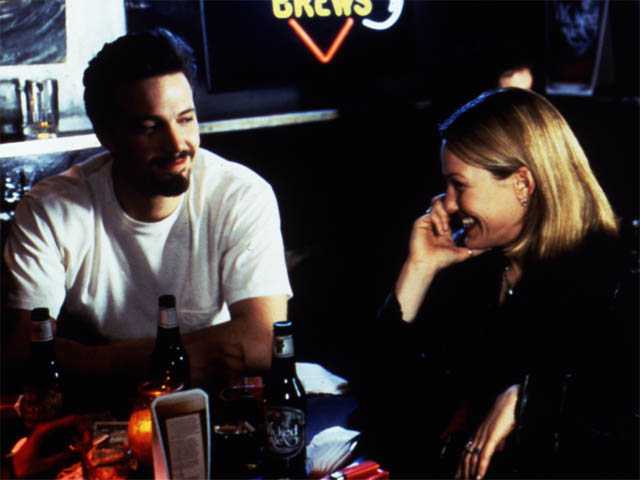
Wendy's Films of 2010 #65: Chasing Amy (1997)

I wasn't taken with this film from the get go, but as the seconds passed I was slowly sucked into the story, the ideas and emotions of the characters. I don't want to ruin too much, because I went into this film not knowing what it was about and it was that much better because of it. Synopsis? Holden (Ben Affleck), a comic book writer, meets and becomes infatuated with Alyssa, a girl who dates girls. Their friendship becomes complicated when he tells her he's in love with her.

Unfortunately, I couldn't stop staring at Ben Affleck's goatee. Now don't get me wrong. I'm a fan of the facial hair when it works, but on Ben it looks like a fuzzy marmot has been taped to his baby face. Yet Kevin Smith manages to suck you in nevertheless, with moments of sheer hilarity and utter sadness. Jason Lee is arrogant, yet strangely charming, so I thought he deserved a mention. The role played Joey Lauren Adams (Alyssa) is one of a woman simply trying to be happy, regardless of labels determined by the world around her. Labels plague our lives - jock, skater, bisexual, straight, smart - so seeing someone attempting to shake the previously determined classifications of our culture is refreshing.

Tuesday, February 16, 2010

Wendy's Films of 2010 #40: Pierrot le fou (1965)

I'd somehow worked up this film in my mind to be something somewhat different from what it was. It's not that it isn't characteristic of Jean-Luc Godard's films, but the story was a little less engaging than I'd hoped. I did enjoy it, but it didn't sweep me off my feet. I'll have to watch it again with a friend who loves French New Wave. New Wave isn't something you should watch when you're not in the mood; I wouldn't suggest watching anything if you're not in the mood for it, really. It is a great example of Godard's work, however. At one point, Anna Karina's character asks Jean-Paul Belmondo, "Who are you talking to?" "The audience," he replies. I love parts like this. The colours are magnificent; bright yellows and blues add exuberance to this film about love and loss. Karina and Belmondo have wonderful chemistry, and I love how she continues to call him Pierrot, though he always replies, "My name is Ferdinand."

Wednesday, February 3, 2010

Alert: Scads of Criterion discs going out of print!

At the end of March, a truckload of Criterion Collection titles (including some only recently released) will be going out of print, destined to sell for ridiculous prices on eBay. If you want to snap up some of these titles before it's too late, we can order them in for you, but the sooner the better. The titles on the chopping block:

Alphaville
Carlos Saura’s Flamenco Trilogy (Eclipse Series 6)
Le corbeau
Coup de torchon
Diary of a Country Priest
The Fallen Idol
Forbidden Games (Criterion and Essential Art House editions)
Gervaise (Essential Art House edition)
Grand Illusion (Criterion and Essential Art House editions)
Le jour se lève (Essential Art House edition)
Last Holiday (Essential Art House edition)
Mayerling (Essential Art House edition)
The Orphic Trilogy
Peeping Tom
Pierrot le fou (DVD and Blu-ray editions)
Port of Shadows
Quai des Orfèvres
The Small Back Room
The Tales of Hoffmann (Criterion and Essential Art House editions)
Trafic
Le trou
Variety Lights (Essential Art House edition)
The White Sheik

Tuesday, February 2, 2010

Wendy's Films of 2010 #27: L'Eclisse (1962)

It seems fitting that I would praise Errol Flynn's wondrous laugh in my last review, just to go on and admire Monica Vitti's sunny laughter in Michelangelo Antonioni's L'Eclisse. Every shot of her is like looking at a stunning photograph, in fact most shots in the film are. After ending a serious relationship, Vittoria wanders the city and eventually meets a young capitalistic man who seems more eager to attain beautiful possessions than meaningful relationships. The film's meaning is vague, but also strong. Films like these seem to be more concerned with creating emotion than fulfilling a plot. Whether Antonioni is attempting to comment on consumerism, industrialization or the immensity of the world around us, it evokes feelings of uncertainty, happiness and asks questions that might never be entirely answered. Vittoria lives on the outskirts of the town, where the roads are wide, new buildings are being built and space feels too open. This is contrasted with the apartments of her male and female friends, which are filled with seemingly empty possessions, closed off with curtains and shutters. Vittoria is a breath of life into these spaces; her smile offers hope and her childlike desire to run through fields or admire a man's drawing of flowers feels like Antonioni's way of seeing through the problems she and the rest of the world encounter.

Wednesday, January 20, 2010

Chris 2010 Viewings #13: The Friends of Eddie Coyle


US, 1973. Directed by Peter Yates. Starring Robert Mitchum, Peter Boyle, Richard Jordan.

The Friends of Eddie Coyle is the kind of picture that didn't make any particular waves when it was released, but made fans at every step of its journey from first run theatres to revival houses to late night TV to videocassette. It was unavailable on DVD until last year, when Criterion leased it away from its indifferent copyright holder, Paramount.

As someone who was born near the beginning of the 70s, and whose formative years were spent watching the 70s go by, I can testify that this movie is very, very 70s, and I don't mean anything disrespectful by that. The score by Dave Grusin is pure 70s funk-fusion. The haircuts and clothes and cars and houses and decor are the kind of thing you saw everywhere in the 70s. The film stock is the kind you only ever saw in the 70s. The sound recording - with dialogue and background noise at nearly equal volume - was only ever acceptable in the 70s. The changing attitude towards mainstream cinema - with casual cussing and no real central hero to root for - and movie stars - Robert Mitchum as a common hood on his way out - is very 70s.

The supporting cast are great character actors, familiar to those who've spent quality time with 70s TV: Alex Rocco, fresh from his massage with unhappy ending in The Godfather; Joe Santos, James Garner's cop pal from The Rockford Files; Steven Keats, whose IMDb page suggests he guested on every show produced in the 70s, yet I can't place exactly why he's so familiar.

And then there are Robert Mitchum and Peter Boyle as two criminals turned stoolie in order to escape prison sentences. The former is the title character, the latter a bartender of his acquaintance, and neither knows the other has turned informant. Both know the same people and so their use to undercover cop Richard Jordan is limited, depending on what information the other has squealed.

The title is ironic, because Eddie Coyle has no friends, only acquaintances; their loyalty to him ends when they find themselves in a jam, and vice versa. It could be a tragedy, were it played out in sentimental fashion, playing up the angle of Eddie as loving family man with the son who wants to know "will ya be at my ball game next week, pa?" and Eddie says "You bet, champ, I wouldn't miss it for the world", knowing that he could be in jail or dead by then. Instead, Peter Yates just observes these characters, none really any more important than the others, in their comings and goings and the inevitable grimy end most of them come to when their loyalties are to cash and saving their own skin. In spite of some killer heist sequences, it's a movie that surprises in a low-key way, and hangs in your mind long after the more flashy enterprises are long gone.

Tuesday, January 19, 2010

Chris 2010 Viewings #11: The Baron of Arizona


US, 1950. Directed by Samuel Fuller. Starring Vincent Price.

When you see Sam Fuller's name on a movie, you know it's going to be an odd one. One of the most subversive directors to ever work within the studio system, he usually found a way to combine social commentary with such oddball subject matter that even if you knew you were being preached at, you don't much mind because it's so deliriously peculiar. One of the great American films of the 1960s is Shock Corridor where Fuller tackles the major, controversial issues of the day - racial, political - in the guise of a lurid murder mystery set in a mental institution.

The Baron of Arizona is Fuller's second film, and nowhere near as wild as his later pictures, but has a definite eye for the odd. Based on a real historical figure, the film follows the exploits of James Reavis (Vincent Price), who contructs a massive con trick and forgery to claim ownership of the entire state of Arizona. Price is ideally cast, in his pre-horror icon mode, as his oily charm allows him to insinuate himself into the trust of some Mexican peasants, Spanish monks, gypsies, and Americans in order to set up his cunning plan. Though we - and Fuller - are never really on his side, Price's insinuating charisma has you half-hoping he can get away with it, even though we know from the opening scenes (and hell, history) that he doesn't. Fuller even gives Price's Reavis a happier ending than history did.

Monday, January 18, 2010

Creepy Pedro Reviews "The Exterminating Angel"


I warned them! Didn't I tell the improbable Mexican aristocrats that they must not rise above their social station lest they suffer the consequences of my wrath?

If they were worried about starvation, they should have packed a taco. Rather than fear baldness, they could have donned a wide sombrero. Had they put aside their evening wear and instead worn their comfortable ponchos, they would have escaped the ire and condemnation of me...yes, THE EXTERMINATING PEDRO!

A mistranslated title has confused film students for almost fifty years. Solemn, bearded young women unplug their cherrybomb mouths and scream "What was it all about, Pedro?" because they do not know my full name, they do not know my predilections, they have been tragically mislead.

You see, The Exterminating Pedro admires and respects Mexican culture, especially the jolly antics of the Mexican Jumping Beans. To me, Mexicans and their film directors are like flies in a washbasin, pleasing when they link arms and copulate and play their grand pianos. Otherwise they anger me, so with newspaper or poisoned frijoles I smite them 'til they're DEAD.

But still the girl with the goatee is screaming "What did it all mean?" so let me explain a few things. When the Mexican lady saw a plastic hand floating the darkness, that was MY plastic hand, seeking alms and offering salvation. She screamed because of the Mexican complex about religion, finance, land ownership, imperialism, cleanliness, and The Alamo.

What about the bear and the sheep? Those were MY bear and sheep so please don't touch them.

Why didn't the victims simply leave the room, she asks? Because I wouldn't allow it! I am The Exterminating Pedro! This is all you need to know!

Enough...stop shouting, bearded lady, or I will put you in a room with nine other people who are much like you and equally vapid. I, The Exterminating Pedro, grow weary of your buzzing. Like I did with the improbable Mexican aristocrats of 1962, I wave my plastic hand for silence. You have been warned. You will play or die.

Friday, January 15, 2010

tm Does the QT 20 Part 3: Dazed and Confused


Dazed & Confused (dir. Richard Linklater – 1993)

Remember the joke about Seinfeld as the show about nothing? Well, this is the movie version.

This movie is takes place on the last day of a Texas high-school in 1976. School gets out, the older/graduating kids party, drink, smoke, get stoned, make-out, ponder what to do next while the kids going into high school worry about getting paddled as an initiation, some get to party with the older kids and so they get to drink, smoke, get stoned, make-out and ponder what to do next. Day breaks and most kids go home while a few drive to Houston to buy tickets for an upcoming Aerosmith concert.

I can see the appeal to this movie growing with repeated views; as QT said, they’re like old friends. And that there’s not much going on in the way of plot isn’t an automatic stumbling block, but with this movie, things drag. Further, this movie might be faulted for launching the careers of Matthew McConaughey and Ben Affleck but thankfully this movie preceded Linklater’s infatuation with Ethan Hawke…

The dvd has a few deleted scenes and a commercial for Vans shoes – not worth it.

tm sez: 5/10

Wednesday, January 6, 2010

Wendy's Films of 2010 #3: 8 1/2 (1963)

Yes, I know, it's completely appalling that someone who just recently completed their film degree had not yet seen Frederico Fellini's masterpiece 8 1/2 (1963). Trust me, there will be several films on this list that I believe I should have already seen, and I'm glad to have the time and ability to explore them.

Fellini's 8 1/2 is a film that I immediately knew I would have to watch again. Besides its absorbing story and beautiful characters, it's full of things to take in and I simply don't think that it can be fully grasped with just one viewing. The struggles of being a director, the uncertainties of life and the choices made throughout it are viewed through Guido Anselmi, a man who seems lost in deliberations on love, women and his art. Take the time to view this film, which has been lauded as one of the most important films ever created, and if you're like me you'll somehow be affected to your soul without quite knowing why.