Showing posts with label Maggie 2010. Show all posts

Sunday, January 2, 2011

Maggie's Top 10 Movies of 2010

I watched just over 300 films last year, though the bulk of them were older numbers, and I didn't get to see certain films around which there is still a tremendous amount of buzz--so before getting indignant about Black Swan and The Social Network not being on this list, didn't see 'em! Sure they're fantastic! Will get around to them in time.

In the meantime, what I did see from this past year was pretty darn awesome:

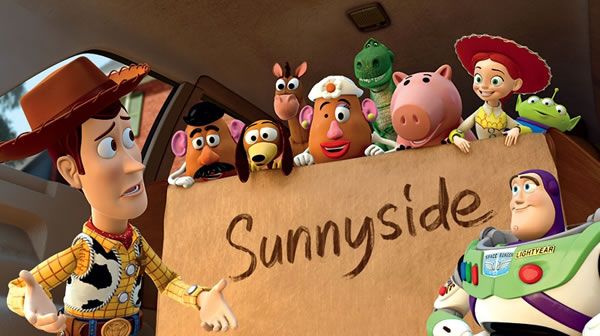
1. Toy Story 3


An existentialist children's film with shockingly well wrought symbolism and metaphor. 'Nuff said! (Chris said it best anyhow!)

2. A Prophet


Jacques Audiard's stunning treatise on the function of prison in creating hardened criminals. Full review here.

3. The Secret in their Eyes


A tremendously graceful fluidity between past and present marks this Argentinian film about a retired legal counsel's pursuit of a long-unresolved murder investigation. The stylization of this film brings viewers quite unawares to its chillingly conceived resolution. Sadly, I only wrote my review for this film in my head, but I'm sure a couple of the reviews here aren't entirely brain-numbing!

4. My Son, My Son, What Have Ye Done?


A lifetime's narratives are condensed in this latest work by Werner Herzog. Full review here.

5. Exit Through the Gift Shop


This documentary follows the man whose compulsion for filming brought him to the world of street art, and Banksy. Or is this film at all what it seems? Full review here.

6. Inception


I gripe a lot about suspension of disbelief being key for my enjoyment of film. Well, Nolan masterfully handles a concept of immense fantasy in a gripping and detail-oriented manner. It doesn't matter that you know where this film is going to take you. It matters that this film makes you more aware of the devices at work in story-formation throughout all contemporary film. Sadly, I didn't get around to reviewing this film at the time, but the internet is abuzz with people still trying to "make sense" of the piece. (Hint: It doesn't need to be analysed to be enjoyed, so if you don't "get" it, you're fine. Relax already.)

7. True Grit


Everything I didn't like about A Serious Man--the intelligently wrought scenes pushing towards an overwrought argument for the absurdity of trying to find meaning in our lives--was honed to a point in this startlingly self-aware western. Again the Coen Brothers prove to be experts, too, at literary adaptation. I don't have the most accessible of reviews for this piece, because it immediately set off the literary critic in me, but I do have a review of sorts here, if you don't mind the academic tone.

8. The Kids Are All Right


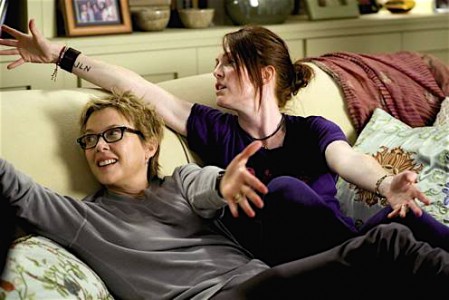
This film, following a lesbian couple as their full-grown children seek to reconnect with their biological father, is an eminently familiar "dramedy" with a few expert twists on age-old genre crises. Full, nit-picking review here.

9. Scott Pilgrim vs. The World


Our abiding desire to find what is good in life amid the hyperbole of modern technology finds a beautiful home in this graphic novel adaptation (set explicitly in Toronto!) about a meek band member and videogame geek who suddenly has to defeat seven evil ex-boyfriends. Playful, sweet, and self-effacing, this film is eminently re-watchable. In fact, I was too busy re-watching it to review it. Sorry!

10. Restrepo


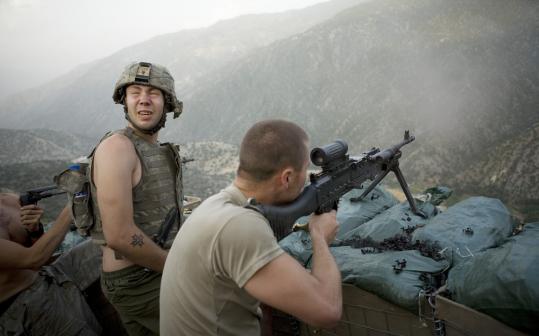
Documenting a combat scenario in which we are currently embroiled is never an easy task, but this effort is impressive. Its approach to foregrounding footage of a year with one platoon stationed on Afghanistan's deadliest front line cannot fail to sober viewers as much as it informs them of the complexities of this unending, unjustified, and un-winnable war. I didn't even know where to begin with a review for this piece, so let me just emphasize that this is a hard, but essential film to watch.

YOUR TURN, FOLKS! What did you watch and enjoy most from 2010?

Wednesday, December 15, 2010

Maggie 2010: Julianne Moore being quirky and hot, but definitely straight

#122. The Kids Are All Right


I was so excited by the premise of this film, the almost unfathomable Hollywood normalcy of its family-drama structure, that I had to restrain myself from seeing it right away. Yes, it is super-cool for a mainstream film to centre around a lesbian family with two adolescent children. Yes, it is super-cool that the ever-attractive Julianne Moore plays the spunky, wayward, gentler partner in the arrangement. And heck yes, it is super-cool that not one of the problems inflicted upon either "child" and parent lies outside the realm of mundane happenstance, thus avoiding the tedious problem of exceptionalism that usually mires queer representation in film.

But let's try to keep our pants on, shall we? (Even if Julianne Moore won't!) While The Kids Are All Right scores tremendous points for its even-handed approach to the failings and quirks of each character, and the script-writing allows for some rare insights into domestic life absent even from other family dramas, there are a couple hitches that keep it from being a perfect film.

The first is pretty straightforward: The film tries far too hard to emphasize "Look! They're lesbians!" in its opening scenes, with some awkward intimacy shots which, in stark contrast to the vitality and breadth of later heterosexual sex scenes, only further highlight the experience gap between queer characters and straight-identified actors.

(It's a similar problem to the one that afflicted Bound, but hey--a lot of people really like Jennifer Tilly, squeaky voice and all, so maybe I'm just picky.)

The second hitch is the teensiest-tiniest character plot-hole around an event that propagates one of the oldest family drama issues in the book. But to explain this, I suppose it would help to know the plot?

Right. So, fifteen-year-old Laser (Josh Hutcherson) asks his just-turned-eighteen-years-old sister Joni (Mia Wasikowska) to contact the sperm bank from whence half their DNA was first wrought. Both then set out, without telling either of their loving mums, to meet their biological father, Paul (Mark Ruffalo). When mums Jules (Julianne Moore) and Nic (Annette Bening) find out, both are uncertain about (and Nic is downright resistant to) the idea of further interactions with this man. Nonetheless, one by one the seemingly idyllic family is drawn into the Charms of Paul, and... well, you can guess where this is going.

Indeed, every predictable detail of the classic dramatic infidelity arc emerges in The Kids Are All Right--which is, again, awesome in its normalcy: absolutely nothing about what happens here is emphasized as different from what occurs in heterosexual relationships where one partner feels ignored or under-appreciated, and lacks the ability or desire to address these concerns head-on.

But what really tweaks me? What really doesn't follow naturally? Is the narrative creakiness and strange mental leaps driving the inevitable discovery sequence. To my mind, more insight into Nic's character was definitely needed to naturalize her suspicions regarding Jules' cheating. It's a small point, but in the midst of one of the most predictable sub-plots for this sub-genre, a key one.

For the most part, of course, I adore Lisa Cholodenko's directing of this film--in particular, the way all characters and their life perspectives are presented evenly and compassionately. I also thoroughly enjoyed her collaborative writing with Stuart Blumberg, as between the two of them they managed to keep Paul firmly secondary to the central family's narrative arc, instead of permitting the lone male's quest to supersede all others. And certainly, this is a film I will recommend to anyone who, for whatever blisteringly incomprehensible reason, still thinks family drama is entertaining.

But for all the accolades this film is currently receiving, it still has to be said: this is more or less your average dramedy, with average issues and averaged outcomes. And that's okay. In fact, to me, that's what truly makes The Kids Are All Right the achievement that it is.

Monday, December 13, 2010

Maggie 2010: Allan King

#121. Dying at Grace


Watching this film isn't the hard part, though its subject might suggest otherwise. A 2003 documentary from the esteemed Allan King, Canadian tour de force and influential component of cinéma vérité, Dying at Grace follows five terminal patients through their final days at a Toronto palliative care facility. Not exactly the lightest of themes, I know.

But this isn't a disturbing film. Sad, yes. Human, definitively. But even as it dawns on viewers that all five patients look the same near the end, the dark, sallow lines of their failing bodies and the steady gurgle of their slowing breaths is not depicted as grotesque. It simply is.

The hard part comes after the film, when returning to the usual gamut of vibrant TV imagery: the anti-ageing ads, the eHarmony Marry!-go-round, and show after show teasing apart every conflict-filled aspect of our active lives. What lessons can be gleaned from a film like King's, I wondered--and how can any of us hope to make use of those lessons going forward?

Carmela Nardone, Joyce Bone, Eda Simac, Rick Pollard, and Lloyd Greenwood were kind enough to share their last days with Allan King and his crew. Their offering above all else makes the aforementioned question more than mere mental exercise. Consider, then, the diversity of their stories:

Carmela was a devout Catholic, loved by her family and unwilling to complain about any pain that befell her.

Joyce, at least agnostic and just as loved by her community, was afraid to sleep and expressed much frustration with her flagging body.

Eda was a civil servant who refused to see her friends while in hospice, instead maintaining a fierce hope that she would survive her cancer.

Rick was a man with a difficult past--homeless after a brutal childhood, struggling in later years to improve his lot in life--whose memories haunted him near the end.

Lloyd was a minister whose brain cancer caused him immense suffering, and whose family was never far from his bed.

All looked the same in the end. Despite the wildly disparate paths each had taken in their lives, the great equalizer of mortality made everything but each patient's immediate discomfort a matter of little importance. And why not? The hospice beds turned over regularly. Patients entered and left through the morgue mostly within the month. In this strange world of constant deterioration and fleeting last connections, pain management trumped all else.

Thus those who monitored this new way of life--the soft-spoken staff of the Salvation Army Toronto Grace Health Centre--themselves became marvels under King's watchful eye. As a viewer, and an outsider, I didn't agree with all they had to say in gentle conversation with their wards--I didn't care for one nurse's response to Joyce's articulation of embarrassment, for instance; I likewise didn't care for a counsellor's response to Joyce's frustration about her mental state--but the attentiveness of their care speaks for itself.

After all, the inescapable fact is that we all die, and many of us first undergo a considerable measure of bodily deterioration. In the course of this transformation, from youth and vitality to outer forms in which we hardly recognize ourselves, we then tend set aside our politics, our old quarrels, or attachments and our dreams, and enter a new world--a world that, if we're lucky, is well attended by people who hope to ease our discomfort, our pain, for what little time remains.

In this manner the external falls away. We lie down, and we sleep. To those around us we become frail and strange things, until one day we simply cease to wake up. What we leave in our wakes then is ultimately those who are still alive.

Those, that is, who will endure their own final deterioration in time, but who for now have no reason not to anticipate, and relish, all the unpredictable tomorrows that lie somewhere in-between.

Who for now can say, "Wow, what an incredible film," reflect for a moment on King's unrelenting compassion, and then reach for the remote to see what else is on.

This, too, simply is.

Saturday, December 11, 2010

Maggie 2010: A Period Piece with Depth

#120. The Last Station


Leo Tolstoy, for those who will not recognize the name, is considered the world over to be one of the greatest writers ever to have lived. Even if you've never read Anna Karenina, War and Peace, or The Death of Ivan Ilyich, you can take it on good faith that this 19th Century Russian author laid an extraordinary and unmatched groundwork for the realist novel, the importance of comprehensive world-building, and the use of a truly omniscient narrator--one capable of both expansive objectivity and intimate, detail-oriented portraiture of all characters in its care.

Sadly, none of these achievements, and the great bevy of acclaim they won the author himself, protected Tolstoy's message from the distorting influences of time and community--which is why, in The Last Station, viewers find themselves thrust into a rights battle over Tolstoy's writings, as enacted between Vladimir Chertkov (Paul Giamatti) and Tolstoy's wife, Sofia (Helen Mirren) as Tolstoy (Christopher Plummer) enters the final months of his life.

What seems at first a simple matter--Chertkov wanting Tolstoy to will his works into the public domain; Sofia wanting the works' copyrights to remain with the family--is reflected by the strenuous idealism of young Valentin Bulgakov (James McAvoy), a fervent man moved by Tolstoy's work and keen to serve the egalitarian cause established on Tolstoy's estate; but both deceptively simple matters are quickly complicated by the same life principle: love.

On one level, then, The Last Station is an elegantly styled excerpting of Tolstoy's later life, carrying the viewer right up to his death and perhaps only lingering too long, too predictably, on the immediate emotional aftermath. In this way it is an absolutely "harmless" film, leaving a vague and fuzzy feeling of contentment among viewers, but intrinsically demanding little more.

But on another level, there is also tremendous room for debate seeded amid the light discourse of this film. By juxtaposing a tale of young love with old, and the routines of lovers with the routines of political combat; and by especially emphasizing the outsider status of anyone attempting to judge the merits of a relationship who is not in fact part of that relationship, the film easily arises at a much more profound argument for the impossibility of perfect communication.

Thus, as the film progresses, Chertkov's "mankind," the presumed benefactors of open copyright, becomes a little narrower in scope, while Sofia's "family," the people she claims to want to protect by keeping Tolstoy's works financially useful, broadens to stand in for a wide spectrum of identity politics. And though Tolstoy is no longer around to worry the issue by the film's end, the question remains long after the credits roll: If even our greatest thinkers and writers cannot control the message or the consequences of their words, are the rest of us in even greater peril of miscommunication--or does their failure instead speak to a universal condition, in which we are all blind men attempting to describe the great elephants of love and politics in the room?

If the latter, then it was perhaps Tolstoy's greatest gift, made elegantly manifest in this film written and directed by Michael Hoffman, that we should at least have the presence of mind to be aware of this difficulty, and to regard each other with compassion and humility accordingly.

That, or just make a lot of love to a lot of people while the getting is good. After all, in The Last Station, no one--not even Tolstoy himself--is as good a Tolstoyan as they at first might seem. But they certainly do try!

Sunday, December 5, 2010

Maggie 2010: Banksy Banksy Banksy!

#119. Exit Through the Gift Shop


The last thing one might expect in a film ostensibly about Banksy, the most acclaimed street artist of our time, is the soothing masculine narration of a traditional documentary. And yet amid the madness of a character who swiftly emerges as the film's central agent, a Frenchman who acquired a camera once and thereafter would not put it down, such a traditional gambit becomes, if not imperative*, at least understandable.

Exit Through the Gift Shop orients itself around the story of Thierry Guatta, a French immigrant whose compulsion to film everything first leads him to discover that his cousin is the famed street artist "Invader," who affixes mosaics of Space Invader wherever possible in public spaces. From this discovery Guatta launches into a Gotta Catch'em All quest to videotape street artists in process, but wherever he goes finds himself limited by the most elusive Pokemon artist of them all:

Banksy.

Author of some of the most provocative and daring street art of our time, including work on the West Bank and a Guantanamo Bay mannequin in Disneyland, Banksy is noted for maintaining an extremely low personal profile, so Guatta's tale of falling in with him had to have a point unto itself: specifically, Guatta had to convince his street artist friends he was working on a documentary.

This flimsy conceit, its pathetic follow-through (complete with some amusingly direct commentary from Banksy's obscured profile), and the new quest Guatta claims Banksy ultimately set him upon mark the major turning points in the film--as well as a whole whack-load of questions from reviewers about whether Exit Through the Gift Shop is genuine or another Banksy installation piece.

Regardless of its veracity, the real joy of this film is not its declarative statements: it's the thrill of watching street artists deploy their creations in the heart of the city, day and night alike--on rooftops, under bridges, over billboards, around telephone poles, and throughout the streets.

Moreover, one needn't buy into the suspicion that this story is too wacky to be real** to enjoy the gentle self-effacement that goes hand-in-hand with the semiotics of documentary--specifically, the way the very framing of this subject in serious film argues that street art is high art. Indeed, every time someone in the film talks about the legitimizing benefit of their work being filmed, we cut to a scene of someone falling from a ladder or a rooftop, spilling paint or otherwise making an unfortunate mess of themselves. This, for me, never ceases to be a point of delight.

As for the conspiracy theories about this film being a hoax, I will say this much: Guatta's depicted failures in Exit Through the Gift Shop, both as a documentarian and then as a street artist in his own right, after years spent filming others at work, do not seem at all unrealistic. Quite frankly, the street art Guatta creates is very much what one would expect from someone whose dominant trope has always been the lens--a sort of self-conscious, superficial deconstruction of paparazzi/celebrity culture.

However, if it eventually turns out that this film very much was a hoax/installation piece unto itself, I will be saddened not by that measure of falsity but by the possibility that Guatta's absurd attempt at street art documentary, which Banksy thoroughly dismisses on camera himself, doesn't actually exist somewhere--a moldering P.O.S. just begging to be reclaimed by cultural studies and psych students alike in the decades to come.


*Has Herzog taught us nothing about how to handle bizarre personalities in film?
**Personally, I've seen wackier: and after Dear Zachary, nothing will ever convince me real life isn't invariably stranger than anything a documentarian or street artist can create.

Tuesday, November 23, 2010

Maggie 2010: A Diatribe About Alien Morality

#118. The Abyss


Sometimes customers ask me why Gen X doesn't have a special director's section for James Cameron (Aliens, The Terminator, T2, Titanic, Avatar, etc). Rest assured, the power duo of our fine establishment has delightfully catty answers more than worth the one-on-one inquiries, but I'm happy to say I've finally found my own, five-word rejoinder to the issue, which goes a little like this:

"Have you seen The Abyss?!"

Forget the insulting alien/"primitive cultures" let's-all-focus-on-the-white-man's-destiny! narrative of Avatar: if you want really asinine alien foils, you've gotta watch this P.O.S. 1989 film.

See, there's this ballistic missile submarine lost in a deep ocean trench that needs to be salvaged, so the U.S. sends in a SEAL team to retrieve its warhead via an experimental underwater oil platform. One member of the drop team is Dr. Lindsey Brigman (Mary Elizabeth Mastrantonio), who conveniently has an estranged husband, Bud (Ed Harris), to contend with on the oil rig -- a common enough device in disaster flicks that you have to wonder if couples in movies ever repair their broken relationships through non life-or-death means.

Meanwhile, the weather's getting really shitty and strange creatures (Non-Terrestrial Intelligent Lifeforms) pop up with enough frequency that one of the team members, Lt. Hiram Coffey (Michael Biehn), eventually tweaks due to High Pressure Nervous Syndrome (and with a name like Coffey, no one saw this coming?). Being military and all, he thus wants to blow up whatever's lurking in the deep, while everyone else thinks that isn't such a good idea. Merriment and death ensue.

Okay, so that's not too spoiler-y, but this next part will be--because when I invest a couple hours in a film I tend to get really pissed off when the payoff is a patently absurd use of alien species as deus ex machina. I'm looking at you, Knowing!

So (SPOILER) Bud and the gang foil Coffey to a degree, but he's still managed to deploy the warhead they were all sent to retrieve in the first place. Thus, somebody's gotta go deeper than any human's ever gone before to disarm it, and Bud bravely volunteers for the task. On his way down he's texting the old school way, via arm-mounted computer device, and he and his wife fix all their assorted problems while he waits to die. (Actually, this is pretty convenient, as marital resolutions go.) But wait! He doesn't die after all, because those strange lights he sees at the end aren't just from the pressures of deep sea diving: they're signs of an alien mothership, where an alien/angel figure takes him and saves his life. How sweet.

Oh, but it gets sweeter. With thousand-foot tsunamis just hanging around the world over, these aliens admit to Bud that they`re responsible for all the crappy near-apocalyptic conditions on the surface. The reason? Well, they flash TV images of war and poverty at Bud, implicitly demanding that he account or atone for human monstrosities. Bud offers his average-and-decent-working-guy rejoinder, then asks them why they aren`t just wiping humans off the planet if we`re so terrible. The aliens` response is priceless: they flash pictures of the text messages Bud sent to his wife about loving her and the duty of sacrifice. Aw. Cue the rolling back of these massive tsunamis, and when Bud and the gang are returned to the surface, it`s with the feel-good message that the aliens would just like us to be a little nicer to each other from here on out. Smiling military officials on the surface seem to agree. Double aw.

You know, it`s hard enough trying to comprehend how people wrap their heads around an omnipotent being`s justification in wiping out most all of creation in a massive flood for the sins of certain adults, but when you try to suggest that an incredibly advanced alien civilization would a) watch human transmissions so selectively as to miss every single feel-good TV program promoting all the good things people also do, b) be more willing to commit genocide themselves rather than just put a warning buoy around the whole solar system to warn other alien species away from our nuisance planet, and c) change their (selectively wrought!) verdict for the fate of the entire human race on the basis of a single text message... you lose me. You really, really lose me.

Dear James Cameron: Aliens with the technology to interfere so profoundly in human affairs are probably not morons, unless you`re also considering how moronic it would be for any more advanced civilization to bother with a species as idiotic as ours at all. You yourself KNOW this, because somehow you managed not to fuck up the very movie Aliens (thank you, Ridley Scott, for all your help in this regard--though that certainly doesn`t give you a pass for Robin Hood)!

With Avatar, Cameron at least had the weak excuse of lifting an overdone story from many other venues--so the stupidity of Pocahantar with Wolves is not entirely his own. To my mind, however, The Abyss gets no such free pass. It`s just (dear reader, you were waiting for this: be honest) Abyssmal. And that is my new personal reason for being proud to work at a video store with a No James Cameron Director Section Policy in stringent effect.

Also, Titanic. But that`s a whole other can of worms.

Sunday, November 7, 2010

Maggie 2010: An Evening of Atheism and Faith

#117. The God Delusion Debate


I'm a secular humanist--an atheist, that is, who much prefers self-identifying by what I do believe in, and not by what I don't. I also use the term "secular humanist" to emphasize a broader community--of Christian humanists, Jewish humanists, Muslim humanists, etc--with which I ally myself over nihilists of any stripe, even atheistic ones. For this reason, despite thoroughly enjoying Dawkins' works on science and nature, I steered clear of The God Delusion, a work that explicitly argues (among other things) that even modest, personal theism is complicit in the atrocities of extremism. And yet I pounced on The God Delusion Debate the first chance I got.

The reason for this difference in reaction was that last word in the title: "debate." As it turned out, I was thoroughly looking forward to a fair discussion of The God Delusion, and the Fixed-Point Foundation, a Bible Belt organization committed to defending Christianity, seemed an especially intriguing choice to sponsor such an event. That said, I didn't know what to expect when Prof. Richard Dawkins and his opponent, John Lennox, a professor of mathematics at Oxford (and the philosophy of science at Green Templeton College) sat down with US Federal Judge William H. Pryor (moderator) to respond to each of the six theses of The God Delusion. Nonetheless, while the very existence of this civil public debate in its part of the world was impressive, I was rather immediately disappointed by limitations in structure that stripped the whole affair of any status of true debate.

Though the host of the event alluded to "Christian charity" in giving Dawkins the first and the final word of the night, the actual "debate" involved Pryor reading an excerpt from The God Delusion, then Dawkins being given five minutes to expand upon that quotation, and finally Lennox responding to the topic for five minutes, before all parties were expected to move on to the next thesis. Very quickly, this became a very unsatisfactory structure for thoughtful discourse, as Lennox's counters would invariably leave tremendous points of contention that Dawkins then struggled to answer in the five minutes allocated to his explication of the next thesis topic. Later in the "debate," the awkward format of the affair also left Lennox attempting to juggle response with thoughtful comment on the next thesis--to the extent, even, that his closing remarks were abbreviated to a mere two minutes, out of deference to the live TV audience also tuning in.

Pryor himself observed, late in the evening, that their time "has been used a lot by free exchange," but while this comment was made as gentle reprimand toward both debating parties for regular breeches of the event's bizarre debating structure, it was precisely the lack of free exchange that so weakened the experience as a whole.

However, the structure of the event was not its only weakness. Despite being an advocate of Dawkins, and never having encountered Lennox before, I must say that Lennox was easily the more composed of the two, while Dawkins, clearly uncomfortable with the format of the night's events, spoke with a startling vagueness for which he can only hold himself accountable. More puzzling yet, Dawkins even permitted, as the event progressed, an unfathomable slip regarding Hitler, such as perpetuates (by association with Stalin and Mao) a gross misunderstanding among many Bible Belt theists about the religious beliefs Nazism took to such monstrous extremes. Certainly, Dawkins grew more confident and coherent as the debate progressed (and indeed, as he and Lennox pushed the event's format to its limits), but Lennox scored more clear wins (by applause alone) in the audience, and for me, at least, Dawkin's explanations for his more steadfast and extreme statements in The God Delusion went weakly answered in the course of the actual event.

Would I recommend this film to others? Absolutely--but more as a teaching tool, a clear demonstration of why true debate is so important, and why no cult of ideology should ever blind any of us to the importance of good, strong argument. As Winston Churchill once said, "There's nothing I like less than bad arguments for a view that I hold dear." The God Delusion Debate is rife with these--but also, I hope, the seed of more thoughtful and truly engaged debates to come.

Tuesday, November 2, 2010

Maggie 2010: Zombie Vs Zombie

#115. Dead Outside


I sat down a couple weeks ago with two of the latest zombie/zombie-esque flicks that seemed to have similar plot-lines, because I'm all for movie death matches and hey! zombies! Enough said.

To this end, both The Dead Outside and Mutants follow a couple of survivors in an embedded post-apocalyptic scenario where huge swatches of the population are, at the very least, dead inside. In both films, other survivors enter the picture; and also in both films, the introduction of other people makes a real mess of things. (Preliminary conclusion: Be wary of strangers when surviving in a post-apocalyptic world.) Despite these similarities, however, the two films are very different -- both in breadth of execution, and in overall quality.

The first of these "zombie" flicks, The Dead Outside is very much an independent film, but I don't want to give it a pass on these grounds for some of its blatant weaknesses, including a script that features some rough transitions (the worst being a really painful line leading into a chunk of exposition) and a partiality for shots so darkly lit that it's often difficult to make out what's going on. (Read: One can use natural darkness effectively, by heightening our other sensory inputs [the chase scene in Dirty Harry comes especially to mind], but sadly, this wasn't done here.)

Strengths in this film by Kerry Anne Mullaney absolutely include the acting of lead survivor, April (Sandra Louise Douglas), who harbours a secret absolutely justifying her prickly reaction to outsiders when they emerge. Even Daniel (Alton Milne), the wayward traveller who finds the homestead she's been maintaining in the wake of a deadly infection, plays his wide-eyed role adequately. Furthermore, the secret the lead character harbours creates interesting opportunities to expand on zombie/rage virus canon -- but sadly, these aren't developed anywhere near as well as they could be. A third walks into the the two survivors' midst, stirs shit up for a while, and in the aftermath of all that hoopla more than a pleasing ambiguity remains regarding next steps. Indeed, the film ends on a meandering and lack-lustre note belying the promise of its premise (say that three times fast!), and seems very much a waste of some splendidly selected scenery and an exceptionally broody lead.


#116. Mutants


Mutants, on the other hand, harbours a very similar secret in the form of its lead character, Sonia (Hélène de Fougerolles), but this French film by David Morlet is executed with a mind to the well-tread canonical ground into which it ventures. Truly, some of the shots in this haunting film, which adopts underground, vehicular, and hospice locations to the credit of some exemplary attack sequences, call to mind the best and most disconcerting scenarios in the acclaimed Left 4 Dead series, and the variation of weapon choices also speaks to a writer and director well versed in zombie survival lore.

But most impressively of all, the human beings at the beginning of this film act like human beings -- which means sometimes people get shot up for No Good Reason, and yes! sometimes people make horrible, life-altering mistakes. Moreover, when the opening scenario occurs, setting into motion all of the events to follow, it isn't treated with over-the-top cinematic gravitas, but established above all for its senselessness. This is one director who truly understands that the greatest threat of all is always fellow human beings, and their propensity both for fear and for error.

Inevitably, not all points or characters in this film sustain that ridiculously high standard -- one female character verges on comical in her blatant adherence to sycophantic stereotype; one misunderstood villain is turned into an over-the-top hero -- but as poor lead male Marco (Francis Renaud) struggles to retain some semblance of dignity and humanity while turning into a monster, and Sonia struggles to protect both him and the greater social order in the aftermath of their stake-out for rescue, some truly high calibre shots, conversations, and ideas emerge. Mutants is a quality addition to a genre that has already seen a lot, and well worth a viewing by any committed zombie fan.

Saturday, October 30, 2010

Maggie 2010: HALLOWEEN PARTY SURVIVAL GUIDE

So it's the day before Hallowe'en, and you're scrambling to finish your costume and get party supplies for tonight and tomorrow. Problem is, you're already hung over from Friday, and someone forgot to grab movie picks from Gen X a sensible time in advance--say, Wednesday, even Thursday, to beat the rush.

Now you know you're going to be shit out of luck for most of the new horror films--which is too bad, because Pig Hunt, about an epic quest for a mythic giant pig that takes its heroes into the realm of nympho pig worshippers, is just the right kind of ridiculous. And if you haven't seen The Human Centipede yet, what, are you living under a rock? A rock with no centipedes???

As for contemporary classics like Let the Right One In and Evil Dead: please. You'll be lucky if one of the sequels to Resident Evil or Underworld got left behind. (But check, just in case.)

Speaking of zombie films, there are some kick ass numbers out there. We've got every "of the dead" you can imagine -- including the more recent Survival of the Dead, but the zombie hit list also includes more sombre fare like Mutants (which is an awesome film, with really intelligent human interactions, but requires English subtitles, and for this reason might not do as well in a rowdy crowd), so wade carefully through piles of the dead!

So what do you do? Well, first you see if one of the Feast films is in--the series a clear party favourite because each film makes fun of its genre for you, leaving you with more time instead to say and do really dumb shit in the company of "friends" who may or may not help you puke into your porcelain god of choice a few hours down the line. You know, because that's always fun.

Still can't find a movie that's in? Cover all your mainstream bases by checking out the following:

1) Cabin Fever
2) Scream (It's better than you remember.)
3) Sleepaway Camp
4) Trick 'r Treat
5) Alien
6) Se7en

All out? That's cool. You know what works for parties? Vagina dentata. Say that three times without a shiver coursing down your spine, and then rent Teeth. It's awesome in crowds.

Too light-hearted? Check out my Staff Picks wall for The Orphanage. Del Toro loves killing children in his films, and damn, is he ever good at it.

Still too light and fluffy? You have two options:

1) Go gore-fest crazy: Dead Alive (you will NEVER look at zombies the same way again), Poultrygeist (you will NEVER look at fast-food the same way again), Ichi the Killer (you will NEVER look at people the same way again), or August Underground (you will NEVER... well, actually, it's hard to look at anything the same way after watching this: Win!); or

2) Go bizarre: Eurosleaze classic The Devil's Nightmare, Fulci's Zombi 2 (complete with a scene where a SHARK, A ZOMBIE, AND A NAKED CHICK FIGHT EACH OTHER UNDERWATER), Otto: Up with Dead People (note: read the case CAREFULLY before deciding to traumatize your friends with this one: the trick is not to let on how grossly inappropriate this film is until you're already halfway through, and there's no turning back!), or They Live! (for the glasses scene alone -- trust me, a clear crowd favourite for sheer ridiculousness, as all John Carpenter films are).

NO NO NO, you say: You've got it all wrong -- this is a CHILDREN'S party! A family-FRIENDLY affair! Don't you have something my kids can watch without wetting their beds after?

Fiiiiine:

1) Wallace & Gromit in the Curse of the Were-Rabbit -- Delightful fun at the expense of misunderstood monster rabbits. WARNING: Many vegetables were harmed in the making of this film!
2) Arsenic and Old Lace -- A classic black-and-white flick about two sweet little old ladies and the dreadful menace they pose to lonesome gentlemen (complete with the ever-unsettling Peter Lorrie!)
3) The Dark Crystal -- You've never seen muppets so utterly terrifying.
4) Labyrinth -- You've never seen DAVID BOWIE so utterly terrifying.
5) It's the Great Pumpkin, Charlie Brown -- If you don't like Charlie Brown, well, you're just a bad person. The End.

BUT MAGGIE! you might then ask -- being kind and courteous that way -- if we're all renting these fantastically fun party films, what will YOU be watching for Halloween?

Good question! The answer: Kimjongilia: A documentary about the tyrannical dictatorship of Kim Jong Il, and the cult of personality that has allowed millions of people to have lived and died in fear, oppression, and almost complete isolation from the rest of the world.

Now THAT'S scary.

Happy Hallowe'en weekend, everyone!

Wednesday, October 27, 2010

Maggie 2010: Kiyoshi Kurosawa, Part II

#114. Seance


I entered the world of Kiyoshi Kurosawa's films seeking a deeper understanding of the most striking motifs in Asian horror -- the designer labels, as it were, that trickle down into the off-the-racks imagery of Ringu, Ju-On, and Dark Water. My first stab at Kurosawa's canon, Cure, gave me confidence in his strength as a director, but did little to quench my curiosity about Asian horror mythology itself. Seance, on the other hand, was nigh on perfect in that regard.

However, I should stress first that Seance is not (for me) a perfect film in and of itself. This is because I put a lot of stock into the ease with which any one film allows me to suspend belief in its causality--namely, to accept the rules of the distinct world I'm occupying for an hour and a half. But with Seance, these mechanics seemed to change without clear justification around the halfway mark, and while I understood by the end of the film what Kurosawa wanted us to see as an inevitable series of events, that inevitability was not as clearly wrought throughout as it could have been.

For some context to that last paragraph, the film's premise is fairly simple: Junko and Sato are a modest couple--Sato (Koji Yakusho), working in sound production for a TV station; his wife (Jun Fubuki), a genuine psychic with few opportunities to exploit her abilities. While reluctant to help a researcher interested in her gift, Junko leaps (passively, almost imperceptibly) on an opportunity to lift the burden of household finances from her husband when a missing person's case comes her way. When the missing child conveniently escapes from her kidnapper only to end up in Sato's sound equipment, Junko sees this, too, as an opportunity to establish herself and start the money train rolling. Fortune does not, however, favour her daring or her cunning--and least of all the poor, wayward child.

This is the playing field into which some truly marvellous deconstructions of Asian horror archetype emerge--everything from the spooky crawling form of a child (is it alive? is it dead?) up a flight of stairs, to spirits haunting the living on a deeply personal level (are they real, or are they just manifestations of guilt?), to the staple "face obscured by hair" shot that's pretty much iconic in Asian horror. Kurosawa even goes so far as to directly address a central conceit of many Asian horror films, in a dialogue between husband and wife where both agree that their desire to deviate from the norm, the social expectation of living a mundane and unremarkable life, is what has led them to utter ruin.

But while all these archaeological details are a sheer delight, and themselves wholly merit viewing the film, I still find such a lack of clear causal relationships in Seance, especially on the part of the wife, as makes it impossible to get fully behind this film. I recognize that many of these difficulties are cultural (I disliked Ringu for the sheer passivity of the female lead, but absolutely cede the point that the widespread expectation of a passive female in that context was meant to make her rare proactive moments even more striking to viewers), but a few incongruities also seem to surpass common sense.

Why, for instance, did it take so long for husband and wife to realize they'd need to hide their identities from the child for their plan to work? What signs did viewers get that the husband was so burdened by his work it had become utterly, immediately imperative that his wife strive to free him from his day job? And let's just say it: Why the hell didn't the little girl call attention to her presence in Sato's box when he moved it to his trunk? ("Fear of men after just being kidnapped" doesn't work: she got into the box knowing full well it belonged to a man. Hell, to that end, why didn't she just say "Mister! Mister! My kidnapper's chasing me!" when she spied Sato at work in the woods? Because that would have made for a very short movie, of course.)

That said, Kurosawa has an impeccably measured style, and many of his shots are extremely thought-provoking. From what I could see in Seance, his use of horror archetype is quite serious and mature, and in this sense a real treat. Yes, I have reservations about the consistency of his characters' moral engines, but no question exists in my mind regarding Kurosawa's talent as a maker of fine, suspenseful films.

Tuesday, October 26, 2010

Maggie 2010: Kiyoshi Kurosawa, Part I

#113. Cure


If the phrase "Cerulean blue is like a gentle breeze" is familiar to you, you already understand the concept behind Cure, Kiyoshi Kurosawa's elegant 1997 psychological thriller about a series of murders carried out by a gamut of strangers on their loved ones--and one man's power of suggestion behind it all. The murders all follow the same gruesome slash pattern about the neck and chest, but their culprits, all caught near the scene, cannot recall why they've done what they've done. Detective Kenichi Takabe (Koji Yakusho) and psychologist Makoto Sakuma (Tsuyoshi Ujiki) join together to find the link between these seemingly unrelated attacks, hitting at last upon the story of an unnamed drifter who has passed into and out of all their lives.

One strength of this film, which first saw Kurosawa's fame as a director spread to mainstream North America in 2001, lies in how little the thrill of the hunt, a classic element in many criminal horrors, plays into Cure's resolution: rather, the Detective finds his man, an apparent amnesiac who invariably turns interrogation back onto the interrogator, halfway through the film. "Who are you?" the enigmatic hypnotist keeps asking, attempting the same techniques on the Detective that have turned so many other, mild-mannered men against their partners in the past.

From this point on a different kind of hunt is at play, as the supposed amnesiac hints at a clear philosophy behind his actions, a conviction that no man can be made to do what he does not already wish to, at least somewhere deep inside. The stakes of such a statement are made even higher by the Detective's personal circumstances, his wife struggling with a mental illness that requires all his off-hours attention. Of all the victims that have preceded him, with loving, doting wives and partners all their own, surely this "burden" above all others should make the Detective easy prey for the drifter's power of suggestion.

And so an expertly drawn battle of wills, oriented around a few serious questions of personal culpability and the power of suggestion, ensues. But while the conclusion might seem obvious, the path Kurosawa takes to get us there most definitely is not. This was my starting point to Kurosawa's work, and I most certainly do not regret entering his world here.

Wednesday, October 13, 2010

Maggie 2010: Nostalgia Lane

#112. Merry Christmas, Mr. Lawrence


This film holds such a dear place in my heart that I can't offer up a standard review of it. In fact, this was the film that awakened me to the special role of alternative video stores, and changed forever my perspective of popular canon -- specifically, all the works that the mainstream can and does so easily cast aside.

In my childhood I must have watched The Bridge on the River Kwai dozens of times, and to this day it remains a classic, a top twenty pick and perfect distillation of the "noble war" mentality taken to its inevitable precipice, then destroyed. Despite my age, it was clear this film represented one of the most important lessons learned (and often thereafter forgotten) in the last century.

Then, when I was thirteen, friends and I went to Suspect Video in Toronto to stock up for the first of our soon-to-be annual anime marathons. I'd never been in a video store like this before -- darkly lit, its titles ordered alphabetically in long bins like you'd find in record stores, to be flipped through one by one with no means of expecting what manner of film might come next.

It was in one of these bins that I encountered Merry Christmas, Mr. Lawrence, which due to my love of The Bridge on the River Kwai immediately piqued my interest. One of the things my friends and I found so wonderful about the anime we'd been watching was the wealth of queer representations -- explicit or implicit -- between leads therein, but to come across a film with all the gravitas of The Bridge on the River Kwai, which also boasted such dignified alternative representations, almost defied comprehension.

To watch the film itself was not to overcome that sense of incredulity -- not then, and not even now, on second viewing, after more than a decade has passed. This is because, while dealing in similar measure as The Bridge on the River Kwai with questions of pride and shame among soldiers of different cultures in World War II, Nagisa Oshima's 1983 film goes one further: featuring David Bowie as the enigmatic POW Jack Celliers and Tom Conti as Sgt. John Lawrence, Merry Christmas, Mr. Lawrence also offers a poignant and brutal reminder that other human conflicts do not subside simply because one is at war.

Homophobia, for instance, doesn't fade into the background; nor does the abject cruelty of our past and foolish selves dissipate from the mind's ever-present eye. Rather, we always carry the complications of our lives at peace into the tempest of war, and only with immense inner clarity can we then use these experiences of the former to mitigate our actions, and reactions, in the latter.

So it is in this story of a POW camp run by Colonel Yonoi (Ryuichi Sakamoto), where Sgt. Lawrence's past experiences in peace-time Japan make him the perfect cultural liaison between prisoners and guards, but by no means spare him from the whims of camp officers like Sgt. Gengo Hara (Takeshi Kitano). At the outset of this film the question of homophobia comes immediately to bear on day-to-day camp operations, and provides a lens through which to view events that follow when Celliers is brought to the prison under Yonoi's behest. Because of the era of this film's construction, director Oshima is able to play more surely with flashback than could sensibly be conceived in 1957, the year of The Bridge on the River Kwai, yet that sentimentalism doesn't detract from the horror of its surrounding context.

Indeed, Merry Christmas, Mr. Lawrence remains, in the end, an immensely formal piece about a war where attempts at preserving formality existed in stark contrast with the complexity and messiness of human interactions. For this reason, as with The Bridge on the River Kwai, it was easily one of my favourite films growing up, and remains a fond preference even today.

Yet when I watched this film as a wee adolescent, it was not well known. It was not even considerably acclaimed. Years later, when IMDB began to flourish, the film still managed only a paltry rating that further exacerbated its outsider status. People to whom I recommended the film were skeptical; and even if they wanted to see for themselves, how could they? Except in alternative video stores, Merry Christmas, Mr. Lawrence had all but slipped from the prominent lists of worthwhile film. And not everyone, sadly, had loosed themselves from the shackles of big-name video and theatre franchises.

This year, at long last, I watched Merry Christmas, Mr. Lawrence take its rightful place in the Criterion Collection, and for this boost to its profile I couldn't be more thrilled. But I will never forget that, long before this change in favour occurred, alternative video stores always carried its torch -- just as they carry the torch for so many other forgotten or neglected works of quality cinema, each quietly awaiting some new and bright-eyed viewer to pluck it from its shelf and give it life again.

Thursday, October 7, 2010

Maggie 2010: The Horror Fest Continues!

A note before these next six reviews: I have no qualms plunking down a whole TV season under a single review, because episodes therein are deeply connected. However, though this collection of six films rents as one set on three discs, these next six entries -- while wonderfully enhanced by one another -- are full-length films that can absolutely stand on their own. And since I highly doubt most people will have the excuse I had (being sick for a couple days), I also suspect most won't be able to get through all six in one go. So here's a set of independent film reviews, posted in the order I watched the set, to help you prioritize your viewing!

#106. Six Films To Keep You Awake: A Real Friend


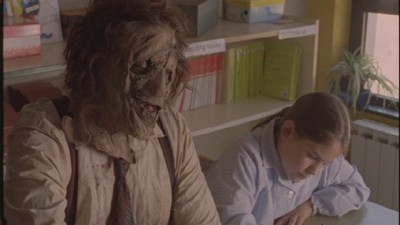
Children are a perfect focus for horror, for they more than any other age group believe in the fluidity of worlds, the power of make-believe. For little Estrella (Nerea Inchausti) especially, the world of horror movie monsters has shored her up against loneliness: in her interactions with mummies, vampires, and chainsaw murderers (which walk a line between real and imaginary that viewers are regularly challenged to reassess) we see a fearless spirit in a tough world -- without friends, without father, but getting along just fine nonetheless.

The real thrill of this film, however, comes from the story of what happens when Estrella, who sees no difference between make-believe and reality, befriends a monster viewers soon discover is real--her father, out of prison, and attempting to regain his family by force. As terrified mother, Angela (Goya Toledo), tries to protect her fearless daughter from the dangers of reality, viewers are propelled through a well-defined tension between strength and weakness, naivete and knowledge. The twist ending is to some extent inevitable -- playful, over-the-top, and crudely satisfying -- but it is this core concept of vulnerability that director Enrique Urbizu captures best in his narrative build-up on screen.

#107. Six Films To Keep You Awake: A Christmas Tale


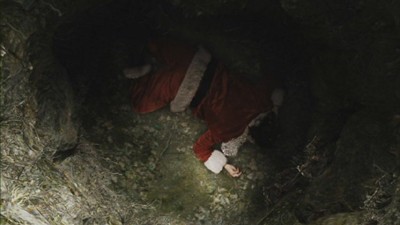
From a place of vulnerability, viewers are treated with the flip-side of childhood: cruelty beyond easy comprehension. When a ragtag group of Goonies-esque marauders discover a woman (Maru Valdivielso) in a Santa Claus outfit trapped at the bottom of a deep hole in the forest, their initial desire to help her is stayed by the discovery that she's wanted by the police for robbery.

Certainly the capacity of adults to dismiss children out of hand is a key point in this film by Paco Plaza, but more severely in focus is the callous, black-and-white view of right and wrong little children can just as easily espouse. Believing that this woman's criminal status justifies any violence or neglect they impose upon her, they hold her captive, starving her while demanding to know where the money is and threatening to let her die if she won't tell them. Long tracts of this film involve watching this woman suffer at the hands of her little tormentors: as with all the strongest works in this collection, this film's use of the supernatural is a very light, ambiguous touch arrived at only when the monstrosity of humankind has run its course.

#108. Six Films To Keep You Awake: Blame


The art of misdirection is alive and well in Spanish horror, as in Blame the supernatural again takes a back seat for most of the ride. When young nurse Gloria (Montse Mostaza) and her daughter, Vicky (Alejandro Lorenzo), are invited by Dr. Ana Torres (Nieve de Madina) to move into the doctor's old, sprawling, and mysterious home, human monsters are initially set up as the centre of this tale. As Gloria learns of Dr. Ana's immense loneliness, clearly tempered in the past by taking in other young women like herself, viewers are left to question what happened to these women in the end; and if the mysterious knocking at an unaddressed door in the house has anything to do with their sudden departures.

It's these surprising twists and turns, occurring on a much deeper level than one expects from a horror film, that make Blame one of my favourite pieces in this collection: while some viewers might not enjoy the absence of a direct progression to the main story, a tale of illicit abortions and murderous fetuses, to me there is a definite realism to this kind of drifting from perceived threats to actual threats. I take issue with a couple scenes that seem flimsy and excessive, but on the whole, this film by Narciso Ibáñez Serrador breaks ground rarely seen in North American horror -- and for that reason alone I have to recommend it.

#109. Six Films To Keep You Awake: Spectre / Moira's Ghost


Surprisingly, this horror collection features two stories about abortion and those who perform it, with this latter film centering on the story of a man both in his old age and naive youth. As a young man (Juan José Ballesta), a strict religious upbringing and an act of kindness only heightens Tomas' desire for the beautiful and secretive woman (Juan José Ballesta) his town despises. Tomas's story arc follows the only natural progression for one as young and narrowly driven as himself: he lusts after Moira, he pursues her, and then he gets possessive and confrontational about her adult life, the parameters of which he simply does not grasp. In his adolescent turmoil he finally makes a choice that has the most horrendous consequences for the lover who has vowed their lives are tied together now forever, and these consequences will haunt him for the rest of his life -- leading him back, as an old man (Jordi Dauder), to the village of his youth, and the wrong that went unavenged.

Again, the supernatural element in this film is a subtle touch, but also a sheer and unexpected delight. Director Mateo Gil takes this realistic piece in a direction that is truly unexpected, providing both a rich tapestry of flawed human characters and a thread of fantasy that binds them in the most fascinating weave to their ultimate fates. I would say this film is my favourite of the whole collection, for its subtlety and its depth of feeling. For gore, though? Not so much.

#110. Six Films To Keep You Awake: The Baby's Room


Finally, a horror film in this collection that's as blunt about the supernatural as anything out of Asia or North America! In The Baby's Room a happy couple tempts fate by daring to point out how perfect their life is -- a loving relationship, a beautiful baby, an old house to call their own -- and reaps the consequences. It's not so much that the house is haunted by the trauma of specific past events, as it is that a malevolent spirit stalks the halls -- and care of an introductory scene taking place years before the main events, we already know that this malevolent spirit likes to switch places with the living in order to wreak further violence in the real world.

This film by Álex de la Iglesia has all the comforting fixings of a truly terrifying ghost flick -- the baby monitors, naturally dark and discomfiting, that father Juan (Javier Gutiérrez) sees the evil spirit through; the classic masculine arrogance that leads him to avoid telling his wife, Sonia, (Leonor Watling) about future sightings when Juan's actions endanger both her and their child; the hidden rooms and ghastly murder scenes replayed within the spirit world. Yes, the ending is a bit predictable, but there is also just the right balance of stark horror and pointed commentary about human relationships leading up to this point, such that viewers are easily on tenterhooks for most of the experience. This is Paranormal Activity, made for TV -- a fun little number with a few good chills.

#111. Six Films To Keep You Awake: To Let


But if any of these six films has wanton horror-fest written all over it, To Let is it. Clara (Macarena Gómez) is just your average pregnant working wife who wants to go home and sleep after her shift, but her husband, Mario (Adrià Collado), has different designs on her time: a viewing of an apartment for let in a really creepy part of town. Again the normal tensions in any relationship, wherein one partner refuses to listen to the other's needs, has dire consequences for them both--because this particular apartment isn't run by just any landlady.

No, Portera (Nuria González) gave 30 years of her life to other people before the city condemned her building and her tenants left; since then, feeling entitled to her own share of happiness at any cost, she's been "collecting" tenants, one hundred percent against their will. In one unit is housed a chained man, a wire bound woman, and a poor baby stuck in the creepiest playpen ever. In the other... well, surprise! Mario and Clara are moving in--whether they like it or not.

There is an excess of violence in this film, making it a clear top pick in the gore department--and the story's pretty original, too, with all the desperate twists and turns one would expect of a horror flick centred on escape. One of the best parts of made for TV film is that one doesn't often see people "wasted" immediately (too many actors), so in To Let people come back when you least expect it, just to be injured more brutally than before. The ending is also deliciously depressing--a perfect note on which to end a collection of rich and diverse Spanish horror treats.
Saturday, September 25, 2010

Maggie 2010: A Lifetime's Narratives, Condensed

#105. My Son, My Son, What Have Ye Done?


There is a point halfway through this film, inspired by the true story of a man who stabbed his mother to death, when director Werner Herzog holds before his viewers three men in near tableau. The man on the bottom right is the murderer, Brad McCallum (Michael Shannon), in a flashback long before he barricades himself in his house with two hostages, an action demanding the full attention of Detective Hank Havenhurst (Willem Dafoe) until SWAT arrives. The man on the bottom left is Brad's Uncle Ted (Brad Dourif), who claims to have once raised the world's largest chicken and now operates a sprawling ostrich farm when Brad brings his theatre director, Lee Meyers (Udo Kier), to pick up a sword prop for a production of "Orestes," in which Brad's character slays his own mother to bring an end to a bloody line of vengeance-seekers. The third man, standing on what one character claims is the "biggest tree on the planet" (I would argue "stump"), is a dwarf in a tuxedo, who speaks no lines in this film at all.

If you have never before seen a Herzog film, I would almost urge you to start My Son, My Son, What Have Ye Done? right here, in the full minute we spend just watching these three watch us back: not because the half of the film that comes before it is lacking; but because here Herzog takes a simple matter of setting his camera on three men, three arresting points against a backdrop of wilderness, and in so doing provides for his viewers a level of estrangement, of implacable restlessness, that has virtually no equal in the cinematic world. You simply cannot take in the image as a whole, and, forced to rely instead on component parts, one at a time, you quickly discover there is no one place to rest your eyes: despite their varying levels of importance to the plot, the film as a whole, no primacy exists at all between these three characters. They simply are, and they are waiting; Herzog is waiting, too; therefore so must you.

The notion of component parts comes very easily to bear on the rest of this film, intersecting as it does with so much of Herzog's preceding canon, and yet administered with such delicacy amid artifice that one can never be quite certain of intentionality. Certainly, the interaction between German theatre director and mad, disruptive actor cannot help but be seen in the light of Herzog's years with the irascible Klaus Kinski. Nor can the flashbacks set amid the mountains and rapids of Peru help but bring to mind the madness narrative of Aguirre: The Wrath of God or the futility arc of Fitzcarraldo. And of course, the very setting, the central framing of the tale around the day's work of a city detective, brings to bear all the genre-specific styling Herzog tinkered with in Bad Lieutenant: Port of Call New Orleans. With so much obvious reference gently laid out for his viewers, the mind begins to see signs everywhere. Is the dwarf a testament to Even Dwarfs Started Small? Is the entire premise of Brad holding so many others to the light of his madness by barricading himself in his home, his fortress, indicative of Signs of Life?

And what of all the birds? Flamingos, ostriches, talk of chickens (which Herzog famously hates); what reptiles were to Terence McDonagh in Bad Lieutenant, birds are, explicitly, as nemeses or alter egos, to Brad here. As Havenhurst deconstructs the events in Brad's life leading up to this slaying of the all-too-doting mother (Grace Zabriskie), he is aided by Lee, the theatre director, and Brad's fiancee, Ingrid (Chloe Sevigny, who looks like she walked off the set of Big Love without a wardrobe, hair, or character change), and witnesses to the murder, Miss Roberts (Loretta Devine) and Mrs. Roberts (Irma P. Hall). The stories therein told cut between past and present with Herzog's usual indifference to gradual transition, but for this abruptness he permits us to linger instead on the unexpected whenever we're thrust upon it -- a "tunnel of time ... a perfect stage for a cosmic melodrama" in the Calgary airport; a cattle market in lowlands Peru; a wide and bracing shot of Havenhurst venturing unarmed into the static cactus and pink stucco landscape of Brad's surrounded home.

Havenhurst's partner, an unseasoned detective named Vargas (Michael Pena), holds up only as a foil in this film, an unexploited nod to the necessities of the cop drama; but Herzog's camerawork sustains no fealty to the slick demands of the same. If Herzog wants a tableau, say, he won't take the easy shortcut of snapping a still, but instead ask his actors to be still, then capture the intimate failings of the human body's every attempt. Similarly, if he's going to zoom in on a murder, he's also not going to worry about getting the shot without minute shaking around corners of the rooms; nor is he going to play that instability to hyperbolic effect: the middle ground simply is what it is. It is "real".

But "real" is, of course, a difficult concept in any Herzog film. At times one might wonder, for instance, why characters like Ingrid and Lee permit so much from Brad for so long -- why he is gently accepted in his bewildering statements and actions, and not left without job or companion. However, in My Son, My Son... Herzog is not stingy with his moments, his glimmers, through which you can see how Brad might have been when fiancee and director first met him: the sense of humour, the intuitive flair for the dramatic arts. Moments, that is, when viewers are left room to assert their own brand of sanity, of inner calm, upon the quiet madness still and always brewing in Brad's converted mind, and from this imposition incur the same, niggling hope for natural recovery that must surely exist in fiancee and friend.

It is, in the end, this unending tension between the blatant, the abrupt, the clearly artificial, and the nuance, the subtlety, the telegraphing of intent without injuring the journey, that sustains this film and establishes its director's brand so classically and elaborately. Viewers know from very near the outset of the piece who Brad's two hostages are, and in that way are freed from a sense of tension, of dread, about outcome as they traverse Brad's richly troubled world. In My Son, My Son, What Have Ye Done? the monstrous has already happened by the time the film begins; the beautiful alone remains to be revealed -- which is why, of course, Herzog's come.

Monday, September 20, 2010

Maggie 2010: Horror Season, Part Deux

#104. In The Mouth of Madness


I didn't even have cable as a kid, and I still remember the corn-ball quality of Nickelodeon horror films, so when I say, "Remember those corn-ball Nickelodeon horror films?" as a lead-in to this friendly chat about John Carpenter's In the Mouth of Madness, you have no excuse for not getting my drift. None.

And speaking of excuses, I have none myself for watching this film alone -- a big, rookie mistake you just can't get away with after viewing other Carpenter classics, like Escape from New York (which some whippersnapper* at Gen X told me was too "old" a movie to satisfy his desire for wanton violence--hah!) and They Live. Ah, They Live. Most amazing fight to plant a pair of sunglasses on someone else's eyes ever. What was my point again? Company, yes! Get some. Seriously: you just can't watch Carpenter on your own. Believe me, I tried. The result? You'll find yourself shouting such delightfully incredulous lines as, "Are they serious?", "Is this a joke?" and "Are you seeing what I'm seeing?" with nobody around to prove that Carpenter isn't in fact driving you insane.

True fact: Carpenter's films will probably drive you insane.

What makes his films so ridiculous? In a phrase, short-term memory loss. Remember where you were when the story begins? Well, that makes one of you. Just like those Nickelodeon flicks of old, Carpenter horror films seem to be written at a break-neck pace with no looking back, ever, to see if everything jives with what came before. And who really cares, anyway, when the movie just spirals further and further into outlandish twists and turns riffing on the most hackneyed plot devices ever invented? Forward, not backward! Upwards, not forward! And always turning, turning, turning towards -- ah, you get the idea.

So In the Mouth of Madness stars Sam Neill as John Trent, an insurance claims investigator commissioned to find a missing author who's "bigger than Stephen King," and whose works have a (pun alert!) "monstrous" effect on their readers. Man, I bet King wishes he'd written this script, too--but alack, no, it's Michael De Luca. And you know what? I also get Neill being down with this script. I can see him saying, "You know what, Carpenter? I fought motherf$#*ing dinosaurs two years ago. Can ya beat that? Well, can ya (punk)?"

And Carpenter can. We're talking worlds pulled out of a fictional writer's behind, garish invasive species taking over human forms by infecting their minds through stories, killer old ladies, mutating hotel paintings, small town sacrificial cults--man, you name it, Carpenter vomited it out for this film.

(On a quick aside, if you're familiar with Southern Ontario, you'll also be pleasantly surprised to see notable Canadian locations like Waterloo County's own kissing bridge in West Montrose, the last covered bridge in all Ontario!, feature prominently in this film. Who knew horror could be so cozy and familiar!)

If you are now of the opinion that I'm against this film, TIME FOR THE TWIST! I'm not. Really! Honest and for realz! Because, let's face it: every now and then we all need films so absurd we can put them on as guaranteed conversation starters--especially at parties, but especially on first dates. Can you just picture it? "Gee, honey, this movie seems pretty crazy, but it's too late to go back to Gen X for another one. Anything else we could do to pass the time?" You just can't go wrong. Really, you can't: not when Carpenter already corners the market on "disaster on celluloid." Unexpectedly addictive disaster on celluloid.

*Yes, I'm aware I wasn't even *born* when Escape from New York came out, but when customers *think* I was around when it hit theatres, I get to be just as cantankerously indignant about "youth these days!"

Maggie 2010: Horror Season Begins!

#103. The Mothman Prophecies


Every now and then a mainstream horror film will tackle grief in a coherent, thought-provoking manner. The film will use grief not as a throw-away lead-in to wanton, senseless violence, but as a means of deconstructing the horror genre as a whole.

To my great surprise, The Mothman Prophecies was such a film. Starring Richard Gere and Laura Linney, and directed by Mark Pellington (whose CV hardly champions him for the genre), I didn't expect this based-on-"true"-events number about supernatural sightings in small-town America to leave any impression on me at all.

Take, for instance, the blatant telegraphing in the opening act -- Gere's character, John Klein, building a future with his lovely wife on the back of a newly-acquired home, only to have a car accident shatter all their dreams, and leave him with a mystery viewers just know will play a central role in events thereafter. Pretty standard stuff, as far as horror/thrillers go, establishing the film's imagery and forging a sympathetic bond between viewer and protagonist.

Nonetheless, The Mothman Prophecies executes this convention well, and even some pretty heavy-handed camerawork near the beginning resolves itself into intelligent scene transitions. Indeed, one of the strengths of this film is easily the level of ambiguity it allows to exist in the details -- even if the conventionality of the form requires the ending to be more blatant, pat, and absolute than viewers might prefer.

But the real strength of the film comes from the director's understanding of why grief works so well as a foundation for horror. In John Klein we see a man who has lost everything that matters--or so he thinks. The events of this film will teach him what remains--and in that remainder, what else can still be lost. Far from being ham-fisted, this message is conveyed gradually, respectfully, and with some interesting twists and turns along the way. Whatever the supernatural agent in The Mothman Prophecies is, whatever greater power it draws upon, in the end the real agency always lies with the humans, not the monsters: the choices we make, and what we can or cannot bring ourselves to take from tragedy, when it strikes.

Saturday, September 18, 2010

Maggie 2010: A Scholar Reviled

#102. American Radical: The Trials of Norman Finkelstein


"Believe me: sometimes I wonder whether it's worth it. ... Speaking as a devout atheist, thank God that in His almighty wisdom He made us mortal. We don't have to endure this for all eternity."
Free speech is one of the most difficult concepts to apply in a democratic society -- and also one of the most important. For Norman Finkelstein, son of Holocaust survivors and active critic of Israel for its treatment of the Palestinian people, free speech lies at the centre of his life's work. Critics think him a self-hating Jew, or no Jew at all, for condemning the actions of the Israeli government and also the use of the Holocaust as a "trump card" forever protecting the Israeli state from accusations of tyranny and oppression all its own. For the controversy stirred up by his books, he has lost his professorship twice and faces hate mail demanding eviction from his home. But is he entirely without fault? Do individual vendettas and rhetoric as high-handed as that which he rails against in the scholarly world make him in some ways personally responsible for the professional setbacks and criticisms he's incurred?

These are the questions asked by American Radical, which I watched after reviewing comments for and against the piece on IMDB. To create a documentary about any controversial figure is always to fail in the minds of certain viewers -- either by not criticizing the figure enough, criticizing him too much, or daring to create a film about the figure in question at all. But I was pleasantly surprised to find in Ridgen and Rossier's documentary an even-handed portrait of a human being, warts and all, whose works are gratefully received by some and reviled by others.

If the film can be said to have any failings, they would include those questions that the directors could do no more than note, including the matter of authority, and of responsibility. In the former case, as critics point out that Finkelstein's fame arises from the fact that he's a "Jew criticizing Israel," and insist that if he weren't Jewish he'd be called out for anti-Semitism in a heartbeat, I'm both inclined to concur and also to sympathize less with that counterargument for being made at all. One rabbi in the film says that it's all right to criticize Israeli (just not as Finkelstein does), but we're never given a sense of just what this "appropriate" criticism might look like. However, far from being a failing of this film, I'm given to suspect it's not a question that can be explored without the film becoming more than a simple biopic; indeed, without the film addressing Israel-Palestinian politics as a whole.

Then there's that second matter, of responsibility: According to critics among university students, as observed around his Canadian lecture tour, Finkelstein's words are dangerous because they give strength, however unintentionally, to explicit anti-Semites, including members of the KKK and Middle Eastern terrorists. The documentary never pushes the question of whether or not a person should self-censor to protect their words from being exploited by others, and again the question seems beyond the reach of a straightforward documentary.

On a personal note, I remember Finkelstein's famed visit to the University of Waterloo, depicted in this documentary at some length, and with it the heated community response that plagued his lecture in full. What I didn't know -- what I couldn't have known -- were Finkelstein's words to his driver after, when criticized for giving time to questions that would undoubtedly drown out Finkelstein's own message in the next day's newspaper articles. American Radical filled in that blank:
"I think it's a question of priorities. I spoke for two hours, and people showed an enormous amount of tolerance in letting me speak for two hours, and therefore I have an obligation to let people have their say. You know, I'm saying things which deeply upset many people in the audience; if they control themselves for two hours, and show me their respect, then I have an obligation to let them let out their feelings and thoughts."

This, I thought, was a beautiful observation, and one that deserves to exist above and beyond the particular politics of American Radical. To give time to an idea with which you do not agree; and which you in fact find deeply offensive, is one of the most difficult acts of civility any human being can manage. Yet even to strive for it is to see the best side of democracy in action. For this reason I think there's a little something for everyone in watching American Radical; and I know I at least came away from it only wanting to challenge my convictions even more.

Friday, September 17, 2010

Maggie 2010: A Little Too... Precious

#101. Precious


Lest I be accused of hating films with "happy" endings, let me first come out explicitly asserting that, yes! I do in fact like films with happy endings. And no, I'm not just talking about the kind where a beautiful woman takes a well-deserved cryo-nap after kicking some serious alien butt. When a happy ending is earned in any genre setting, it's a beautiful thing. It's George Bailey gathering Zuzu in his arms and watching Clarence's bell ring amid New Year's caroling. It's the Tramp too speechless with love to do anything but gaze upon the woman his hard-won charity has spared from blindness, and having her identify him by the gentlest touch. Among more recent films, it's a triumphant Maori girl named Pai surviving immense prejudice to follow her dreams, or an old man touching down in the foreign land he and his late wife had so long hoped to explore. Happy endings are wonderful, especially when achieved despite tremendous losses and through unrelenting hardships; and for this reason, again, yes, I enjoy them as much I do their far bleaker, more unsettling counterparts.

However, I most emphatically draw the line at any film writer/director who thinks they can heap up suffering like so many cold pig's feet on a plate of heavy mash and then sprinkle the magic fairy dust of "BELIEF IN YOURSELF!" to wring a sense of catharsis out of their thus-fatted viewers. As you can well imagine, this is how I felt myself being used while watching Precious.

And I wanted to like Precious. I really, really did. I find the main character, an illiterate sixteen-year-old bearing a second child of incest in a household permeated by abuse, played to perfection by the young and talented Gabourey Sidibe. She really could not have done anything more to make the film a success; I just fervently wish she had a director, a producer, and a script backing her up every step of the way. Yes, to an extent director Lee Daniels was working under the constraints of the film's source material, a 1996 novel by Sapphire called Push, but that remains little excuse for the heavy-handed stylistic choices that reveal monstrous details of personal suffering for emotional effect, then conveniently push them aside whenever the reality of those details threatens the feel-good, YES-YOU-CAN, I-read-The-Secret-and-it-changed-my-life message that's supposed to make us all believers in ourselves by the time the credits roll.

The most obvious example of this is the means by which acts of violence against Precious are immediately glossed over with dream sequences (mostly of Precious-as-celebrity blowing kisses at many admirers). This technique is used a handful of times throughout the film -- when her mother throws objects at her head, when Precious is shoved by punks, when she's giving birth, when she's being raped by her father -- and each and every time it's telling viewers something we already know: that Precious wishes she were anywhere else but then, and there, and in that skin. Well, duh.

The problem with this directorial choice is that it takes the act of empathy out of our hands. Instead of being able to bear witness to Precious' immediate, real-world discomfort or outright suffering, and in the process evaluate her experiences in contrast to our own, we are forced to focus instead on the persistent dreaming that seems to emphasize how she in particular is deserving of escape. In consequence, the audience is not given time to personalize its exposure to Precious' suffering, and Sidibe is similarly denied a crucial opportunity to let her truly striking portrayal of Precious convey those emotional truths all on its own.

Perhaps I wouldn't be so hard on this film if it weren't built on so sensational a groundwork, but as it is Precious packs some pretty heavy subject matter, from incest and rape to physical and verbal abuse, to the transmission of HIV, to basic child neglect, and hunger, and poverty. Yet for all that these issues are foregrounded and indeed blatantly attested to in narrative and dialogue throughout the film, none of them are addressed with the rigour and consistency they deserve.

The most absurd example of this arises when Precious tells a social worker (Maria Carey) she's been raped by her father: oddly enough, no mention is even made of a police report being filed pursuant to that conversation. Thelma and Louise may have questioned the use if calling the police in their rape case (and subsequent manslaughter), but social workers have a duty to report. Another conveniently underdeveloped thread is the question of future romance: Lenny Kravitz, playing a benevolent nurse in the maternity ward after Precious gives birth, is the only clue the audience gets as to how Precious will interact with men from here on out, and even he skedaddles before the HIV matter pops up, a debilitating can of worms all its own.

In fact, one would do well to ask "Where are all the men?" when watching this film. Even the impassioned alternative school teacher, Ms. Rain (Paula Patton), who opens her doors to Precious for Christmas, is conveniently in a lesbian relationship -- a mainstream presentation I'd usually be celebrating, except that here it feels suspiciously like another means by which to avoid having Precious interact with other men in her new life. All Precious' new classmates are female, too, as if boys never need alternative, rudimentary schooling in author Sapphire's world. Precious never even so much as re-evaluates her initial daydream of a life with her math teacher, a male, in her new, post-literacy world.

Indeed, so far as this film is concerned, Precious has essentially waltzed into a fiercely protective women's commune, and that whole other sex, with all their raping and familial abandonment, is of no great import when resolving the film's own crisis points. Confronting the abusive mother is central to this film's conclusion, yes! But when Precious learns how permanently her father's out of the picture, where is even a moment's struggle with the notion of never being able to confront him for what he's done?

Obviously the notion of descending into a community of nurturing women to escape one's traumatic past is a common one: it's at the heart of such films as The Secret Life of Bees, The Joy Luck Club, Fried Green Tomatoes, and The Color Purple (also all novel adaptions).

But ultimately, it's this director's heavy-handed stylistic devices, which so often and so annoyingly supplant an excellent performance from Sidibe, that makes Precious nearly intolerable while the aforementioned others all bear their own strengths (with The Color Purple in particular winning my endorsement over this film, for its integration of men in the protagonist's quest for resolution). So by all means, watch Precious for Sidibe's acting, which amply deserved the 2009 Oscar nom for Best Actress, but don't hold your breath waiting for an ending that's both optimistic and earned. You won't find one here.