Showing posts with label Pose 2010. Show all posts

Saturday, September 25, 2010

Pose Reviews A Movie. #43: Zoolander (2001)

Zoolander presents a deep, philosophical spelunking into the depths of one of the most important and divisive questions with which humanity will ever come to grips.

...isn't there more to life than just being really really good-looking?

Well, in Derek Zoolander's case...not really.

This classic comedy about the world-famous male model with the IQ of a hammer has aged quite well considering it's coming up on its ten-year anniversary.

The premise is indisputably unique, centering around the title character (Ben Stiller) whose critically acclaimed domination of the modeling industry is disrupted when his rival, Hansel (Owen Wilson), takes the coveted Male Model of the Year award.

It's at this point that Zoolander starts to reconsider the value of his career, making him vulnerable to the tempting advances of the evil fashion guru Mugatu (Will Ferrell), who uses Zoolander's all but absent intelligence to lure him into an assassination plot.

In the tradition of Dodgeball, Anchorman and Wedding Crashers, Zoolander sports the absurd and hilariously effective comedic delivery of comedy giants Ben Stiller, Owen Wilson and Will Ferrell. And with fantastic additions made by Jon Voight, David Duchovny and Jerry Stiller, the movie is full of the all-star heavy-hitters of Hollywood.

In much the same way that "the clothes that make the (wo)man," it's definitely Zoolander's cast that makes the film.

The concept is good, the script is good, the plot is good, but the characters are great.

Plus, Zoolander is also saturated with fantastic (and numerous!) cameo appearances, most notably David Bowie as the Right Honourable Judge of the epic walk-off between Zoolander and Hansel.

And if you're upset that I gave that away, let's be honest--don't you want to see it more now that you know there's

a) David Bowie
and
b) The necessity for a walk-off judge?

I'd definitely recommend Zoolander to fans of the aforementioned comedians who star in the film, but I'd also recommend a re-watch for anyone who hasn't seen it in awhile. Having not watched it myself since its initial release in 2001, I had forgotten a lot of the great gags, and even the ones I remembered wear quite well.

Often, what separates the goods from the greats in the comedy genre is the films' ability to endure over time. I think Zoolander admirably stands this test of time, and whether you've seen it already, or didn't surface from under your rock until its popularity had died down, I would give it a second look.

And if you don't like it? Well, I have something that will cheer you up...ORANGE MOCHA FRAPPUCCINOS!

Wednesday, September 22, 2010

Pose Reviews A Movie. #42: Desperado (1995)

A quick Google search of action movies that came out in 1995 will easily explain the merit of Robert Rodriguez's Desperado. That year, Rodriguez's film competed with:

-Mortal Kombat
-Judge Dredd
-Batman Forever
-Waterworld
and who could forget...
-Mighty Morphin' Power Rangers: The Movie

Of course, 1995 also sported the debut of Pierce Brosnan as James Bond in Goldeneye, and the return of Bruce Willis as John McLean in Die Hard: With A Vengeance; films which, at the time seemed pretty cool, but after being rerun on television every week for the following ten years, became (to put it gently) "passé."

This, ladies and gentlemen, was the standard of action flicks at the time Desperado appeared on the proverbial scene. And, when considered within that context, it seems pretty damn good.

Unfortunately, I didn't have the opportunity to watch Desperado's precursor, 1992's El Mariachi, but the updated model is pretty effective as a brainless, shoot-em-up, Benevolent Vigilante vs. Evil Drug Dealing Villains kind of blockbuster.

First, it features Antonio Banderas as one of the greatest badasses since Dirty Harry--a man whose skills in the area of bad-guy-death-killing are second only to his admirable morality in good-guy-looking-out-for. (Read it twice--it's a sentence.)

Banderas is pretty impressive in his portrayal of El Mariachi, a stealthy and cunning stranger who comes to a small Mexican town looking only for "a man who calls himself Bucho," but finding a whole lotta other people in the interim.

After all, Bucho (Joaquin de Almeida) is a man of considerable means, and our hero ends up with a lot of anonymous henchmen to plow through before he gets to him.

Throw in a romance with Salma Hayek and a wicked awesome soundtrack by Los Lobos? Well, you've got yourself a movie!

Certainly, Desperado isn't really going to make you think. But it's sure as hell fun to watch. The action sequences are awesome, and reasonably overdone for effect, and the script isn't as terrible as it usually is when you're dealing with an action movie from 1995.

And it's especially fun to watch Danny Trejo in his role as a hired gun (or...knife), now that Machete has been released. (And if you haven't yet seen Machete, watch it afterwards for some delightful homages!)

Essentially, I'd recommend this slightly formulaic, action-packed feature if you're looking to give your brain a rest, but still want to watch something that doesn't suck. If you're in the right mood, it can be a real treat.

After all, Desperado is pretty decent. You know...for 1995.

Thursday, September 16, 2010

Pose Reviews A Movie. #41: Dillinger È Morto (Dillinger Is Dead) (1969)

Marco Ferreri's 1969 feature, Dillinger Is Dead is an exemplary instance of minimalism done properly.

Frankly, I loved it. But I could definitely see how some people might hate it. After all, "exemplary minimalism" to some is probably "frightfully boring" to others. So I will do my best to present a fair and honest description of the film, and what I saw in it.

Dillinger Is Dead takes place over the course of one evening, and exclusively takes the perspective of Glauco (Michel Piccoli), a middle-aged industrial designer of protective masks.

The film begins with a short glimpse of Glauco's work-life, then moves swiftly toward documenting his evening at home. His wife is in bed with a headache (though we get the impression that she's probably on drugs), and he is left to eat dinner alone in the dining room.

Glauco's dinner has gotten cold, however, and he decides to take to the kitchen and cook himself a stunningly elaborate, multi-course meal.

When going through a cupboard looking for ingredients, however, he stumbles upon something unusual. An old, rusted revolver, wrapped in the front page of a newspaper from the day John Dillinger was killed in 1934.

Stay with me.

What makes this symbol fascinating (to me, anyway) is its ambiguity. Surely, we are meant to believe that this was indeed, at one point, John Dillinger's gun. But how did it get into Glauco's home? Has he owned it for years, and merely forgotten about it? Did someone plant it there? Was it left by a previous owner of the house? And what does it mean that Glauco spends the rest of his night repairing it?

Because he does.

With a running time of 95 minutes, the vast majority of Dillinger is Dead consists of Glauco cooking, occasionally interacting with his wife and their maid, watching some strange reels of film (including a weirdly awesome hand-dance on a sort of mirror, the entirety of which would probably be life-altering to someone who had taken powerful hallucinogens) and meticulously restoring what may or may not be John Dillinger's gun.

That's it.

But the entire time, you get the feeling that the film is building up to something profound. No matter how uneventful the majority of the picture is, you can't help but shake the sense that something big is going to happen.

And that's all I'm going to say.

(About the plot, anyway).

There is very little dialogue in the film, which makes the soundtrack feature quite prominently. And it's a cool soundtrack to boot! The film's music seems to flow in waves of genre--everything from Italian pop to American rock n' roll to salsa--and there's so much of it that you're bound to find something in there that you like.

But aside from the music, I think what I loved most about Dillinger is Dead is its commentary on modern social isolation. Because Glauco himself is a very powerful personification of isolation.

After all, he is a man who makes a living constructing masks which allow human beings to survive on their own in conditions we aren't meant to endure. We almost don't need to watch him spend an entire night in his home to know he must know a thing or two about isolation.

But to watch Glauco is to watch a modern man--alone amongst people, and obsessed with deconstructing and rebuilding an artifact from a previous age.

And I think that the point of the film is to have the audience determine what this means.

Or, at the very least, why Dillinger's gun?

This is the kind of movie with endless potential for post-film discussion.

So find your closest film-nerd friend (and I'll bet if you're reading this blog, you have at least one!) and give Dillinger is Dead a shot.

No pun intended.

Wednesday, September 15, 2010

Pose Reviews A Movie. #40: Pirate Radio (2009)

Lovers of rock and/or roll, lend me your ears!!!

...er...and your eyes for a minute.

It's time to promote the coolest, rockiest and probably funniest nautical comedy ever to grace international waters.

Ladies and gentlemen, allow me to present for your viewing consideration: PIRATE RADIO!

Pirate Radio, much like Do The Right Thing (the subject of my last review) is largely character-driven, but it presents one of the most lovable casts of characters since music-movie classic, Empire Records.

The film is set in 1966, and it depicts life on board Radio Rock, a ship that broadcasts rock n' roll music from outside the jurisdiction of the British government, since at that time Britain was hosting a decidedly ungroovy ban on broadcasting rock over the radio.

Pirate Radio mostly takes the perspective of Young Carl (Tom Sturridge), a troubled lad whose mother has sent him to live on the ship under the guidance of his godfather, Quentin (Bill Nighy) in a misguided attempt to straighten him out after he's been expelled from school.

However, sending the boy to live amongst rock 'n roll DJ's in order to make him a more disciplined, upstanding citizen turns out to be as ridiculous as sending a six-year old to work in a candy shop in order to enforce responsible eating habits.

Carl is swiftly taken under the wing of the ship's record-spinnin', jam-pushin' crew, consisting of radio DJ's all along the spectrum of wackiness. There's The Count (Philip Seymour Hoffman), Dr. Dave (Shaun of the Dead's Nick Frost), Angus (Flight of the Conchords' Rhys Darby) and the mysterious late-night DJ, Smooth Bob (Ralph Brown), who is more of a legend than a man, since he only emerges from his cabin once every twenty-four hours to spin ditties for all the lovers out in Radio-Land.

The cast of characters are what make Pirate Radio such a charming feature, and the personalities of each DJ really shine through when the suave "King of the Airwaves," Gavin Kavanagh (Rhys Ifans) rocks the boat with his return.

And let's not forget Kenneth Branagh as the crusty government minister who tries to shut down Radio Rock from the shore. He really steals the show.

Pirate Radio is full of great moments, and although it's not an outrageous laugh-a-minute gag-fest, it strikes the right balance between substance and humour to make it really worthwhile.

The story is also richly multifaceted, since focus is placed on each of the wonderfully diverse characters, delving into their personal lives, their squabbles with one another, and their reconciliations.

Conflict also occur both on and off the boat, which gives the audience a number of storylines to follow, while the coming-of-age story for Young Carl that underlies the entire film.

And it's impossible to talk about Pirate Radio without mentioning the epic soundtrack. Pretty well every song in this movie is a Britrock hit from the 1960's, and when each scene is kicked off with a classic tune, it's music to any music-fan's ears.

Pirate Radio is a great, lighthearted comedy for music-lovers and movie-lovers alike. I'd recommend it to anyone who digs slightly absurd, character-driven narratives, and also likes to rock out.

This is DJ Pose, signing off.

Saturday, September 11, 2010

Pose Reviews A Movie. #39: Do The Right Thing (1989)

Touché, Criterion Collection. Touché.

I'm not sure why it took me this long to see Spike Lee's canonical breakout, appropriately included in the Criterion Collection, but I'm very glad I did.

The film, which takes place in a small neighbourhood in Brooklyn in the midst of an almost biblical heat wave, provides an excellent examination of race relations and the unfortunate power of groupthink, but it does it with a cast of colourful characters in a way that's genuinely entertaining.

Over the course of one ridiculously hot Saturday, Do The Right Thing takes the time to introduce the audience to the eccentric and diverse staples of the neighbourhood. The action centres around Sal's Famous Pizzeria, and we spend the film following Mookie (Spike Lee) as he puts in a day's work delivering Sal's pizzas. (A clever excuse for capturing all kinds of neighbourhood interactions on camera? Indeed, Spike Lee. Indeed.)

Through Mookie's wanderings, we meet people like:

-Da Mayor (Ossie Davis), an endearing old lecturer whose taste for Miller High Life gives him something of a bum rap on the block.

-Mother Sister (Ruby Dee), a maternal figure who (quite literally) watches out for the community from her front window.

-Buggin Out (Giancarlo Esposito), a friend of Mookie's and an outspoken protégé of Malcolm X.

-Radio Raheem (Bill Nunn), the boombox-totin' giant pictured above.

-And Mister Señor Love Daddy, a radio DJ played by a young Samuel L. Jackson who periodically offers a narrative voice for the events of the film.

And, of course, there's a host of other nearby dwellers, all of whom add to the film's rich tapestry of characters.

The film looks at racial tensions between several ethnic groups, and its inclusion of all forms of prejudice, from the virtually unspoken to the outright violent, makes its message more effective.

It's also interesting that Do The Right Thing doesn't have defined heroes or villains. Each character seems to have elements of both, except perhaps Sal's villainous, racist and hostile son, Pino, fastidiously played by John Turturro.

Overall, Lee's cinematic breakthrough provides a piece of relevant and effective social commentary that's presented not in a preachy way, but in a way that's entertaining and engaging.

After all, you need to feel for these characters in order to care about what happens at the film's explosive climax.

Luckily, if there's anything Spike Lee can do, it's instilling that kind of caring in his audience.

A brief trip to Wikipedia informed me that Do The Right Thing has been identified as "culturally significant" by the U.S. Library of Congress, and I certainly don't disagree.

I'd recommend Do The Right Thing as a classic example of cinematic importance, and invite anyone with an interest in social dynamics to check it out.

I mean, come on--clearly it's the right thing to do.

Tuesday, September 7, 2010

Pose Reviews A Movie. #38: Machete (2010)

Who says you can't make a real movie out of a fake trailer?

Machete, the new feature from Robert Rodriguez, answers this ridiculous question in five swift letters: FOOLS.

Based on the humorous-yet-undeniably-badass trailer preceding Grindhouse: Planet Terror, Rodriguez's new feature packs an impressive punch to end off what has been a relatively ho-hum season of summer blockbusters.

And although it won't be released on DVD for a few months, I feel compelled (nay, obligated!) to stir up some buzz and anticipation for this explosive romp through hell.

Machete continues Rodriguez's experimentation with the exploitation genre--an endeavor he started with Planet Terror--and it's evident that he's honing his skills. Machete has the ridiculous over-the-top violence and gratuitous, totally-out-of-place nudity characteristic of the genre, but it also offers a political commentary which, though decidedly not subtle, offers the film something akin to actual substance.

The plot of Machete doesn't follow the standard revenge-tale archetype in the manner implied by its fake trailer--in fact, Machete himself (Danny Trejo) is something of a reluctant hero. Living a simple life as an illegal immigrant in Texas, Machete seems content doing manual labour for a living wage after an epic betrayal ends his days as a Mexican Federale.

It isn't until a wealthy businessman by the name of Booth (played with just the right amount of scumbag by Lost veteran Jeff Fahey) makes him an offer he can't refuse that he breaks out a few of his old tricks.

As they say, old habits die hard.

...except in this case, old habits don't die. They KILL!

Booth's offer involves the assassination of a U.S. Senator (Robert De Niro) whose excessive stance against immigration would be hilarious if it weren't so reflective of some actual American political figures.

After the assassination goes awry, and Machete learns of Booth's true motives, he teams up with an Immigration Enforcement officer (Jessica Alba) and works somewhat effortlessly to take him down.

The greatest part of Machete is easily the upstanding morality of the title character. He never kills unless it's necessary, he always gives the bad guys an opportunity to consider their misdeeds and run away, and when it comes time to take out the trash, he does so with considerable ease.

Machete is one of the most likeable action heroes ever, and it's delightfully rewarding to see him almost single-handedly rid the film of its evil-doers.

Machete also sports an unbelievable cast, and although the acting is nothing tremendous, some of the big names make it a lot more fun. In addition to the names bracketed above, you get Cheech Marin as Machete's estranged brother and Michelle Rodriguez as a Harriet Tubman figure, running an underground railroad for Mexican immigrants.

But let's not forget the one man who makes Machete shimmer. The one and only Steven Seagal.

Seagal's appearance as the big cheese of evil is nothing short of heartwarming, and his climactic sword-fight with Machete is probably in my Top 10 for Hollywood Fight Scenes, if not only for the eventual outcome.

Machete is an absolute blast, and I'd definitely recommend it to anyone who likes their movies drenched in epic conflict, slimy bad guys and stuff blowing up for no reason.

...and yes, you get to see Lindsay Lohan naked.

You know, if that's your thing.

Friday, September 3, 2010

Pose Reviews A Movie. #37: Insomnia (1997)

Oh Norway...you never fail to impress. First The Bothersome Man and now this? Dare I say...Nor-way to go!

I was originally turned onto Insomnia (the film, not the disorder) when I was going through my Christopher Nolan phase (see my reviews for #30: Following and #35: The Prestige) and expressed an interest in re-watching Nolan's 2002 remake.

Both Chris and Ryan recommended the original, citing its extreme superiority, confirmed by its inclusion in The Criterion Collection.

"Better than Christopher Nolan?" I thought. "GOD'S GIFT TO CINEMA, CHRISTOPHER NOLAN?!"

I had to see it to believe it.

Then I did. And now I do.

Insomnia is the story of Jonas Engstrom, a Swedish police detective assigned to a murder investigation in a small town in Northern Norway. The town, which is located above the Arctic Circle, experiences 24-hour daylight, and Engstrom must fight the effects of unrelenting insomnia while trying to get to the bottom of the case.

It's a cool premise, and the entire film is imbued with a hyper-creepy vibe, due in large part to the acting of Stellan Skarsgård, who plays the lead role. Skarsgård plays a brilliant and cunning detective at first, but later descends into a 'bad cop' archetype, due in part by a grievous error he makes early on in the investigation, and exacerbated by his inability to sleep with the constant daylight.

But make no mistake. Engstrom (Skarsgård) is not a Dirty Harry style bad cop. He's just dirty. In fact, this is one of the best movies I've seen where, despite his undeniable cleverness, the protagonist is someone the audience comes to profoundly dislike.

However, the sinister quality of the main character makes the plot all the more compelling--as Engstrom digs himself deeper and deeper into the realm of amorality, the story gets more and more suspenseful.

I also thought Insomnia did a tasteful job of handling the subject matter of the crime at hand--it's hard to watch a film about the murder of a 15-year old girl, but the violence of the original act is depicted briefly and more or less implicitly, and there are no shocking or disturbing images of it popping up later in the film. It's still not a movie to watch with the kids, but director Erik Skjoldbjaerg makes it as easy to stomach as possible.

Overall, I thought Insomnia was an effectively suspenseful and genuinely engrossing crime thriller, and the added element of a dislikable protagonist works to make it more intriguing. I'd certainly recommend it to anyone who enjoys a good murder mystery, as long as you don't mind reading some subtitles along the way.

Sunday, August 29, 2010

Pose Reviews A Movie. #36: In America (2002)

I'd like to start by dedicating this review to my friend Kate, who initially recommended that I watch In America, and who I know has a tendency to follow the blog.

I miss you KT!! I think it's wonderful that Scotland has swallowed you up, but I'm also counting down the days till you come home. (Right now it's several hundred.)

OK, now on to the review.

Did I like In America?

Yes.

BUT,

was it mostly because of the way it tugs at the heartstrings, and less on account of its technical or artistic merit?

Also yes.

Jim Sheridan's film about an Irish immigrant family settling illegally in New York City after the death of their son is the kind of movie that is designed to wrench your emotions.

It just has to.

But the reason it's OK is because the film exacts its full-on assault of the feelings through style and content--it doesn't rely strictly on either.

Take, for example, the fact that the film is narrated by Christy Sullivan, the elder of the two daughters in the family. This is an effective choice, since her interpretation of the film's events are endearingly skewed by her young age, and having such an adorable narrator guide you through the film helps to soften the blow of some of the sadder and more upsetting elements.

The acting is also very strong across the board. Paddy Considine and Samantha Morton are dynamic as the Irish parents, who try their best to keep themselves financially and emotionally afloat in the Big Apple, all the while attempting to hide the harsh realities of city life from their children.

The two daughters, played by Sarah and Emma Bolger, are also tremendous actresses--their roles call for a sophisticated range of moods and subtle line deliveries, both of which they handle with impressive ease.

All in all, In America is exceptionally made--my only qualm with the story is that it wanders into far-fetched territory at times. The deus-ex-machina quality of some of these extraordinary events is alleviated slightly by Christy's claim that her brother gave her three wishes before he died, but that only makes them slightly more believable within the context of the film.

That said, you can't have a dramatic film without the drama, and certainly In America would be a little boring without the implausible moments to which I'm referring.

And they sure do sting the ol' tear ducts.

Ultimately, In America is a very uplifting film, encouraging its audience not to dwell on the past, but more to look forward to the future. It's also the kind of movie that encourages us to put our own struggles in perspective, and to be more mindful of the struggles of our newly immigrated friends, co-workers and neighbours.

I'd recommend In America to anyone with feelings they haven't used in awhile, and who also has an affinity for happy endings...

...and Irish accents.

Thursday, August 26, 2010

Pose Reviews A Movie. #35: The Prestige (2006)

I remember that when The Prestige came out in theatres, it was released in one of those infamous "Hollywood Pairs" that everyone despises.

You know what I mean.

It happened with Dante's Peak and Volcano. It happened with Armageddon and Deep Impact. And it happened with The Prestige and The Illusionist.

Inevitably, when "Hollywood Pairs" occur, no one sees both. (Unless you're weird. Or you have a LOT of interest in the subject matter.)

Back in 2006, I opted to see The Illusionist because Edward Norton is awesome and I can't stand Hugh Jackman.

The Illusionist was nothing if not mediocre, so understandably my enthusiasm for magician movies was somewhat diminished. Luckily, however, my enthusiasm for Christopher Nolan recently overtook it.

The Prestige is a tale of two competing magicians, Robert Angier and Alfred Borden (played by Hugh Jackman and Christian Bale respectively, neither of whom can really pull off the English accent required for the roles) in early 20th century London.

At first, the men work side by side as partners under the leadership of an illusion engineer by the name of Cutter (adeptly played by Michael Caine).

However, when Angier's wife, the act's lovely assistant is tragically killed as a result of one of the illusions, he blames Borden for her death, and sparks a rivalry that increases more and more intensely as the film progresses.

At first, the men merely try to sabotage each other's stage performances, but when Borden finally perfects "The Transported Man," a trick that Angier cannot figure out, the conflict turns to one-upmanship, and each magician goes to extraordinary lengths to outdo the other and expose his secrets.

The Prestige is a really solid film, and it comes with all the fun twists and turns that you'd expect from Christopher Nolan. Of course, Nolan can't be credited with the story, since The Prestige is an adaptation of Christopher Priest's novel of the same name, but he brings it to the screen with the same mysterious flair present in films like Following and Memento.

The Prestige
also brings David Bowie out of a brief cinematic retirement, giving him his first on-screen role since playing himself in 2001's Zoolander. Bowie does a great job of playing Nicola Tesla, the suave, brilliant but altogether mad scientist, and practically steals the show at the halfway mark.

Overall, I enjoyed The Prestige for what it is: a well-crafted period piece that is suspenseful, mysterious and surprising, not to mention unique (if it weren't for that pesky Illusionist!) I'd certainly recommend it to anyone who enjoys a good story, complete with a legitimately cool twist that won't make you roll your eyes.

...and if you'd rather just stare at Scarlett Johansson, I suppose it's good for that too.

Tuesday, August 24, 2010

Pose Reviews A Movie. #34: 8 1/2 (1963)

Like most movies I end up enjoying, I went into Federico Fellini's 1963 classic, 8 1/2 without knowing anything about it.

The film, which I now know is about a film director named Guido Anselmi who is trying to make a film despite a severe case of "director's block," and frequent interference from the chaos of his personal life, is certainly a classic for a reason.

However, this "classic" status makes me feel a tad philistine admitting that I found it a little tough to follow in parts, and indeed rather slow-moving at times.

The key to enjoying 8 1/2, I think, is to realize that the film exists simultaneously in the director's real life, in his fantasies and dreams, and in his childhood past. (As much as I try to avoid knowing what to expect when I see a film, sometimes garnering this kind of contextual background is a gift rather than a curse.)

So when I finally figured this out around the 1-hour mark, I started to really enjoy Fellini's film. I adored the parallels between Guido's life and the film he is trying to make, and I found the finale to be both beautiful and poetic.

I also liked 8 1/2 because I could see the way it influenced some of my favourite films. Specifically, I thought of Charlie Kaufman--both his directorial debut, Synecdoche, New York and his screenplay for Spike Jonze's Adaptation.

These films are also self-reflexive tales of artists struggling with their art, and I am certain that 8 1/2 was a major influence for both.

Thinking of 8 1/2 in this way, I feel like it's the cinematic equivalent of 1980's brit-rockers The Stone Roses. Whether you like them, dislike them, or have never even heard of them, there's no way you can doubt their influence on the music that came after.

Therefore, I feel confident recommending 8 1/2 to fans of postmodern, self-reflexive narratives like the Charlie Kaufman films mentioned earlier, since it's a deep and rich example of the genre, and sports a truly exemplary instance of a film-within-a-film.

Unfortunately, 8 1/2 has finished its run on the big screen at the Princess Cinema, but you can still rent it from the Criterion section at Generation X! Happy watching!!

Wednesday, August 18, 2010

Pose Reviews A Movie. #33: Caché (2005)

Michael Haneke's Caché is a rare type of suspense-thriller.

It's minimalist. It's super-creepy. And it's refreshingly open-ended.

Caché is the story of Georges and Anne Laurent, an ordinary couple in France who begin to receive ominous videotapes on the doorstep of their home. At first the cassettes, which appear to be shot in high-definition (a technological impossibility, for all intents and purposes), contain surveillance-style footage of the area outside the Laurent's home.

To be fair, this is unsettling at best.

But the theme of the tapes gradually evolve--they depict more and more specific instances and settings, and for Georges, the subject matter gradually gets closer to home (in the strictly non-literal sense).

Caché is an excellent film, not least of all for its commitment to postmodern storytelling. Not only is the film self-reflexive (a film about film) but it also manages to avoid conclusive elements. (The explanation for this can be found in an interview with director Michael Haneke, included on the DVD--he provides some really interesting perspective into what the film is actually about, but I'd recommend watching it after the feature).

Haneke's film manages to be highly compelling despite being somewhat abstract and relatively uneventful. It's one of the more accessible examples of postmodern film that I've seen, and it takes an irresistible premise and totally pulls it off without getting too caught up in lame twists or illogical character leaps taken in service of advancing the plot.

Certainly, the genius of Caché lies in its simplicity, but incidentally that's where the suspense comes from too.

I'd certainly recommend Caché for fans of the suspense/thriller genre, but also to those looking at getting into the films of Michael Haneke. Haneke is known for tackling some pretty dark territory in some of his films (Funny Games certainly comes to mind without hesitation), but Caché is very nonthreatening in its content. The gripping psychological element of Caché subverts the need for shocking images or disturbing scenes, which makes it a great starting point for anyone interested in trying out Haneke's catalogue.

Overall, Caché is the ideological opposite of the most recent film I reviewed, 2003's Canadian feature, Nothing. It takes a cool premise and makes it into a cool movie, and in no way did I find its delivery of the goods unsatisfactory.

So if you're interested in this little gem, don't be shy--Caché is hidden in the Austria section.

Pose Reviews A Movie. #32: Nothing (2003)

Well...it was a good try.

I rented Vincenzo Natali's Nothing for three reasons:

1. I liked the concept of the film.

2. I like to support Canadian film whenever I can.

and

3. Nothing's director, Vincenzo Natali is also responsible for Cube, which I liked a lot, and Splice, which I haven't seen, but am pretty curious about.

However, I'm going to have to say that Nothing didn't do it for me.

Overall, I think Nothing is a cool idea. When the film begins, our protagonists--roommates Andrew and Dave--are each having the worst day of all time. Dave loses his job and his girlfriend, practically before noon, and Andrew, a total recluse, accidentally locks himself out of the house.

Once the two regroup and get themselves inside, they barely have time for a collective sigh of relief before finding that their house is scheduled for demolition, and that they are both being sought after by police for crimes that are neither related to one another, nor in any way their fault.

It is at this point that, quite inexplicably, everything outside the walls of their house disappears.

Quite literally. What used to be the City of Toronto surrounding their home on all sides becomes empty white space, reminiscent of The Construct from The Matrix. (Or for those who haven't seen The Matrix enough times to get that reference, it's the empty white space where they get all their guns.)

Andrew and Dave are able to venture out into this great abyss, since the surface of the void is a bouncy, albeit invisible terrain, and after a while it becomes evident to both the characters and the audience that everything, everywhere, ever...is gone.

As I said before, it's a neat premise.

However, it may have been better suited to a short-film than a 90-minute feature.

As you can imagine, there's not a lot of places you can go when this is the concept of your movie. Nothing manages to survive on a gradually increasing conflict that occurs between the two main characters, but that survival doesn't make it good--it just makes ensures that the film can last the full hour and a half.

But even that's a bit long. The film gets tedious at times, and for a comedy, there's very little to laugh at--the characters are kooky, but they aren't particularly funny. Mostly, they're just odd.

Usually, you have one weirdo and one straight-man to make a comedic partnership like this work. However, with oddballs like Andrew and Dave, it's like watching a Costello and Costello routine...about nothing.

Overall, I'm glad I watched Nothing to satisfy my curiosity about where a filmmaker could take a concept like this.

Unfortunately, the answer is: "not far."

However, from a technical point of view, Nothing is really pretty cool. The effects used to portray the disappearance of things are pretty impressive, and the sound effects and many of the camera shots are exceptional.

But then again, Hollow Man and Titanic had cool effects too. 'Nuff said.

All in all, I wouldn't discourage anyone from renting Nothing--it isn't terrible, it just isn't great.

But if you're interested in it because it's a cool premise, a frank warning: that's essentially all it is.

Friday, August 13, 2010

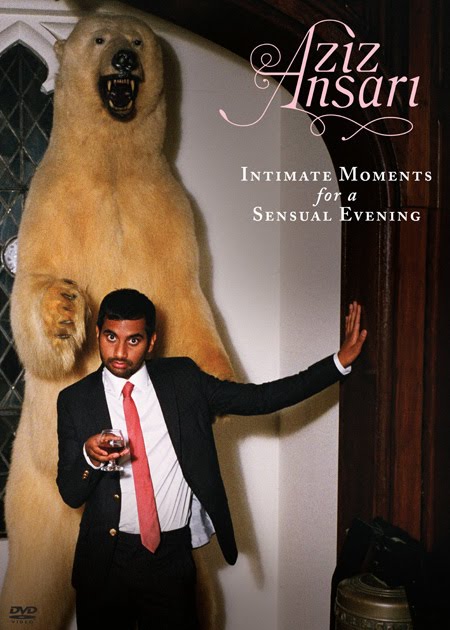
Pose Reviews A...COMEDY SPECIAL! #31: Aziz Ansari's Intimate Moments for a Sensual Evening (2010)

I had originally suggested what I thought was a hip title for fans of up-and-coming comdian Aziz Ansari.

"Hey, you think that guy from Parks and Rec who refused to sell fruit to the guys on Flight of the Conchords is funny too? Totally! That guy's hilarious! You must have the Aziz Disease!"

Sadly, this clever and underappreciated moniker didn't take off.

But I'll tell you what is taking off: Aziz Ansari's DVD, Intimate Moments for a Sensual Evening.

Intimate Moments is a 55-minute comedy special that Ansari performed at Los Angeles' Brentwood Theatre in January, 2010 for Comedy Central.

It also sports a bonus feature containing a 30-minute comedy set of completely different jokes , the sole purpose of which is to ensure that there would be a bonus feature on his then forthcoming, now very much available DVD. (Ansari states this very explicitly at the beginning of this feature).

What's encouraging is, both sets of footage are absolutely hilarious.

It's nice to have a heavy-hitting newcomer to the stand-up comedy scene. Along with Louis CK and Russell Brand, Aziz Ansari seems to be rejuvenating the stand-up enterprise while stand-up veterans like David Cross and Ricky Gervais have been releasing mediocre stand-up performances on DVD of late.

Ansari's humour is mainly derived from true stories (whether they're actually true can be debated, I'm sure, but they're definitely entertaining!) about his own life experiences, including tales of a night out with Kanye West, and a ridiculous story about an R. Kelly concert (complete with an unforgettable impression of R. Kelly).

However, some of the funniest jokes Ansari has to offer have to do with new social networking technologies, from Craigslist to text messaging.

The older stand-up crowd isn't delving into this territory, but there's a ton of golden material to be derived from the ridiculous nuances and idiosyncrasies of new technology and the way people use it.

Aziz Ansari has tackled this veritable jackpot of humour, and he does it with a flair that will make you LOL.

(Sorry. Had to be said.)

I'd definitely recommend Aziz Ansari to stand-up enthusiasts, since he's a clever and charismatic performer who doesn't resort to vulgarity or shocking edginess to be comical.

And while the subject of his humour is funny, it's the wording and delivery of his jokes that make him hilarious.

Need some intimate moments for tonight's sensual evening? You know where to find 'em!

Thursday, August 12, 2010

Pose Reviews A Movie. #30: Following (1998)

A very interesting thing happened after I saw Inception at the cinema recently.

After a standard post-movie discussion with my accompanying friends, I came to a remarkable realization: Inception is probably the coolest movie I've seen since The Dark Knight.

(OK, OK, with the possible exception of Kick-Ass [see Pose Reviews A Movie #28]).

But certainly, Inception brought me to the stunning but truthful realization that Christopher Nolan's latest film is the most impressive movie I've seen since...Christopher Nolan's last film.

And so, I've decided to treat myself to a flat-out Christopher Nolan binge. And as such, I've gone ahead and taken things from the top.

Following is his first feature, from 1998, and depicts the story of Bill--an aspiring writer with an unusual hobby. Or rather, an unusual hobbyist with an aspiration to be a writer.

You see, Bill's writing takes a back seat (way, way back) to his primary occupation: "following."

Bill is not a stalker in the conventional sense--he makes this very clear in the film's opening.
However, the only thing that differentiates him from an actual stalker is that he is curious, not malicious or dangerous, and he obeys a self-imposed rule never to follow the same person twice.

But, since rules were made to be broken, (and arguably, because films need plots), Bill breaks his own repeat-following rule. And this is how he meets Cobb.

Cobb is a thief. Part con-man, part burglar, he is extraordinarily adept at what he does, and performs his acts of thieving with utmost confidence and skill.

Cobb's confidence is what prompts him to approach his "follower," and his skills are what eventually lead him into taking Bill on as a sort of apprentice.

Cobb shares his tricks of the trade so that Bill can take his affinity for following one step further...and then one step further after that...and then one step further after that...until things really start to get out of control.

Following is a fantastic film, and it showcases Christopher Nolan's roots in dark, brooding characters and premises.

It also provides some interesting foreshadowing into Nolan's later works. Consider the following Fun Facts:

1. Cobb is also the surname of the protagonist in Inception.

and

2. Bill, the protagonist of Following, has a large and prominent Batman sticker on the front door of his flat.

Looks like Nolan is still following Following even twelve years later!

I'd certainly recommend this film to anyone who is a fan of the film noir genre, or likes a good con-artist tale.

My only recommendation is to keep in mind that the story is non-linear. The most confusing element of this choice of narrative style is the frequent changes in Bill's appearance. This threw me for a loop at first, but if you can follow the story (har har), these alterations start to make sense as the film progresses.

Also, for anyone who has difficulty with British accents, I'd go ahead and use the subtitles--no one will fault you for it.

Here's hoping that Following will follow YOU home sometime soon--happy renting!

Sunday, August 8, 2010

Pose Reviews A Movie. #29: The Lost Skeleton of Cadavra (2001)

Bahahahahahahaha!!!

Sorry...just thinking about this movie in order to review it makes me laugh.

I can't help it. And if you've watched it, I'll bet you can't either.

The thing to know about The Lost Skeleton of Cadavra in order to enjoy it to its fullest is not that it's bad, but that it's bad on purpose.

Paradoxically, this bad-on-purpose-ness is what makes it really, really good. And incidentally, the sheer magnitude of this bad-on-purpose-ness is what also makes it very, very funny.

To explain, let me use the example of Plan 9 From Outer Space. Plan 9 has endured the test of time and continues to be beloved of current generations because, simply put, it's so bad it's good.

Fans of Plan 9 will know what I'm talking about--you don't love the film because it's great, you love it because it's great despite its awfulness.

The Lost Skeleton of Cadavra takes this concept even further. It capitalizes on the endearing quality of films like Plan 9 From Outer Space because it possesses the same "vintage terrible" quality, only on purpose.

The Lost Skeleton of Cadavra was made in 2001--however, it's designed to look, sound and feel like a sci-fi film from the 1950's.

The film's humour, then, is derived not just from the atrociously corny aesthetic, but also from extremely clever (though equally corny) writing of Larry Blamire (the director and leading man).

So, with this one-two punch of hilarity, you end up with a very funny movie about a mad scientist, a less-mad, more-normal scientist, and two space aliens who are all trying to locate a fallen meteor in the remote woods of rural America to acquire the coveted element "atmospherium" that lies within it.

I highly recommend The Lost Skeleton of Cadavra since it's such a unique and effective parody of a genre that's already pretty funny--namely, relic science fiction classics.

So, if you liked classic Zucker Abrams Zucker parodies like Airplane! and Top Secret!, or the great but oft forgotten Loaded Weapon 1 from National Lampoon, you're likely to enjoy The Lost Skeleton of Cadavra as much as die-hard Plan 9-ers.

And if you're already a die-hard Plan 9-er, you've probably already started watching The Lost Skeleton of Cadavra before even finishing this review.

(And if you haven't...well...you probably should be.)

"I SLEEP NOW!"

Thursday, August 5, 2010

Pose Reviews A Movie. #28: Kick-Ass (2010)

I'll bet you thought I was going to start this review with something lame and corny like "Kick-Ass kicks ASS."

You did, didn't you?

Well forget it. I won't do it.

...

But to be fair, Kick-Ass does kick some serious ass.

As you may have gathered from my review of Dr. Horrible's Sing-Along Blog, I can't resist a film about unlikely or amateur superheroes. (Or, in Dr. Horrible's case, supervillains.)

Thus, it shouldn't come as any sort of surprise that I just watched Kick-Ass for the second time...and loved it.

Again.

Kick-Ass is the story of Dave Lizewski, a geeky teen who, after years of fascination with fictional superheroes, finally decides to don a costume and try his hand at the craft.

As you can imagine, our protagonist encounters some serious drawbacks as the superheroic Kick-Ass, what with the no-super-powers and the no-formal-training and the not-entirely-heroic-physique, but with the help of two highly secretive and experienced superheroes, played by Nicholas Cage and eleven-year old Chloe Moretz, Kick-Ass ultimately manages to...well, kick ass.

I really dig this movie, but if I learned anything from my adoration of 2009's Watchmen, it's that it's tough to give films a glowing recommendation when they also exist in graphic novel form. Essentially, you're almost guaranteed to piss off someone who thinks the movie didn't do justice to the book.

Luckily, with Kick-Ass, the rights to the film were sold before the first issue of the comic book was published. So it isn't so much an adaptation as an alternate interpretation of the Kick-Ass concept--which branched off from the same moment in time as the textual edition.

In other words...score one for Matthew Vaughn! Not only is he married to Wayne's-World-Salute veteran Claudia Schiffer, he also managed to make a superhero flick that effectively avoids fair comparison to the original text. Schwing!

But with that said, even if the cinematic version of Kick-Ass was a straight-up adaptation, I think it would've fared pretty well, even with fans of the comic.

First, the action sequences are awesome--surely they were well-illustrated in comic form, but there's nothing quite like watching eleven-year old Hit Girl flat-out demolish a room full of thugs in real time.

The action sequences are also very creatively presented, with different lighting and camera effects to make each major battle distinct from the others.

Second, it includes a tribute to Kick-Ass' graphic origins with a beautifully effective still-image montage depicting the origin story of Kick-Ass' ally, the superheroic Big Daddy. (Played delightfully by Nicholas Cage, who more than makes up for Bad Lieutenant: Port of Call New Orleans with an eccentric homage to Adam-West era Batman).

And third, it sports a pretty decent soundtrack--something the graphic novel can't compete with unless you're reading it with headphones on. And even then, you'd have to be constantly pressing "Play" and "Pause" at the appropriate moments, which is way more annoying than watching a movie.

Overall, I think Kick-Ass would please graphic novel enthusiasts just as much as gung-ho moviegoers. For a blockbuster action movie, it has an appropriate amount of plot and humour to offset the violence and badassery, and it's charmingly self-aware as a superhero flick about superheroes.

And let's face it. We all have to do something with our time while we wait for Christopher Nolan's next Batman movie.

Friday, July 30, 2010

Pose Reviews A Movie. #27: Death At A Funeral (2007)

Ah yes...leave it to the Brits to put the "fun" back in "funeral."

Frank Oz (AKA Miss Piggy) brings us this celebrated dark comedy all the way from the UK, documenting an ordinary funeral that goes extraordinarily wrong.

The entire film plays like a really, really good episode of Fawlty Towers in the way that many of the characters buzz around, hiding secrets and lying through their teeth in a vain attempt to maintain order and solemnity at an occasion that is quickly and drastically taking a turn for the funny and ridiculous.

Death At A Funeral makes excellent use of awkward and deadpan humour, but it is also not short on laugh-out-loud moments. And I can't possibly review it without mentioning that it sports close-up of two of the best single facial expressions I've seen captured on film.

In short, there's no lack of golden moments, I assure you.

I think what makes Death At A Funeral so humorous, however, is the fact that most of the characters aren't particularly likable.

If they were people the audience could emotionally bond with, the movie would cease to be a comedy--you would just spend the entire movie cringing and wondering why such bizarre punishments were being bestowed upon such lovely people.

But they aren't lovely. Most of the time, they just suck as people.

I mean, you go from whiny but mostly harmless protagonist Daniel on the one hand to Ewen Bremner's character Justin on the other--easily one of the greatest assholes in British cinema.

And I think that's why it's perfectly OK to laugh at the outlandish antics that go on--that, and the antics that writer Dean Craig comes up with are pretty damn funny in and of themselves.

Overall, I'd highly recommend Death At A Funeral for anyone who hasn't seen a good comedy in a while--it may not make you laugh so hard you pee your pants, but...you know...not everything can be Airplane!

Plus you'll save on laundry.

Thursday, July 29, 2010

Pose Reviews A Movie. #26: Crimes And Misdemeanors (1989)

At its most basic, Woody Allen's Crimes and Misdemeanors is a movie about love gone wrong.

Horribly, horribly wrong.

But then again, why does it feel so right?

I liked Crimes and Misdemeanors a lot. In a recent discussion with a friend, I described it as a sort of renovation of Allen's 2005 feature, Match Point.

"It's sort of like Match Point done right," I said.

"But I liked Match Point!" said she.

"Then you'll love Crimes and Misdemeanors!" I said. "It's basically the same thing, except it's funny rather than ridiculously dramatic, and instead of Scarlett Johansson, you get Anjelica Huston."

My friend paused. "...nice." she replied.

And it is!

Although Match Point was made much later than Crimes and Misdemeanors, the latter feels like an improvement on the former.

You have the same essential storyline--a man has an affair with a woman who gets overly clingy, and angsty relationship drama ensues. But Crimes and Misdemeanors brings more to the table--to turn a phrase, it puts more in the soup.

For example, in addition to the primary story about an optometrist's infidelity, there's a parallel storyline involving a married documentary filmmaker Cliff Stern (Woody Allen), who falls in love with his new production assistant (Mia Farrow), who is sought after by the annoyingly charismatic Lester (Alan Alda).

And the primary storyline, which features the impeccably apt Martin Landau as the promiscuous Judah Rosenthal, also has component parts, including a rocky relationship with an estranged brother, and a successful optometry practice that brings him into contact with a contrastingly benevolent rabbi and a genuinely good man who is going blind. (Arguably one of the most philosophical aspects of the film).

But coming back to my original point about love gone wrong, the film is full of examples.

Everything you expect to work out in Crimes and Misdemeanors doesn't, and everything you expect not to work out, does.

It's a very poetic look at love and human relationships, because it presents the non-Hollywoodized and arguably more realistic view of humanity's strongest emotion.

The fact is, people get bored. Then they get lonely. Then they make poor decisions, and before you know it, things go completely awry.

This happens all the time, but so rarely does it happen in the movies without being carefully and brought back into balance.

In that regard, Crimes and Misdemeanors bravely squashes the Hollywood standard by refusing to pick a genre, resisting a nice, clean ending, and giving all the right outcomes to all the wrong characters.

...and the one-liners aren't bad either.

If you're interested in a movie that breaks the rules and doesn't apologize, I say look no further. You can find Crimes and Misdemeanors in the Woody Allen section, or on my Staff Picks shelf.

Tuesday, July 20, 2010

Pose Reviews A Movie. #25: Beetlejuice (1988)

For a movie that's as old as I am, Beetlejuice holds up pretty well!

I've decided to continue my Tim Burton retrospective by taking a look at his zany post-mortem comedy featuring the first performances of a few actors who would become staples in his later films. Michael Keaton (Batman, Batman Returns), Winona Ryder (Edward Scissorhands) and Jeffrey Jones (Ed Wood, Sleepy Hollow) all appear in Burton's 1988 endeavor, and I must say they're quite suitably cast.

The film also includes Alec Baldwin and Geena Davis as the recently deceased protagonists of the film, and Catherine O'Hara, whose performance as the stark-raving mad artiste who drives her family insane is by far one of the highlights of the film.

The premise of Beetlejuice is unique and wildly creative--something Burton's films don't offer anymore. The story follows the afterlife experiences of Adam and Barbara Maitland, a married couple who, to quote The Doors, "break on through to the other side" after their car takes an unanticipated detour into a river.

The afterlife, however, is cleverly depicted not as a terrifying nightmare, but a bureaucratic headache. The Maitlands take a considerable amount of time to figure out what has happened to them, and once they do, they are given only an easily distracted caseworker and an extremely cryptic instruction manual (pun intended) on life after death to help them through.

But as though this post-existence existential crisis wasn't enough for the Maitlands, they also have to contend with the new occupants of their home--the relentlessly irritating Deetz family, consisting of Ma (Catherine O'Hara), Pa (Jeffrey Jones) and angsty teen (Winona Ryder).

The Maitland ghosts attempt to rid themselves of the Deetz family on their own, but when their attempts are continually foiled, they turn to a 'bio-exorcist' who specializes in ridding the dead of living, breathing vermin.

His name? Juice. Beetle Juice.

It's a wacky concept to be sure, but a fun ride overall. The actors are all very committed to their roles, and Burton does what he does best by creating a creepy, haunting aesthetic to balance off the goofiness of the script.

Finally, it's also worth noting the immense amount of skill possessed by the makeup artists who worked on Beetlejuice. A recent discussion with a friend of mine regarding the virtues of practical makeup as opposed to CGI effects gave me a new perspective on the value of good makeup artistry, and the Oscar-winning Beetlejuice exemplifies the power of makeup-done-right. (But you'll have to watch to see what I mean!)

Overall, Burton's post Pee-Weenian, pre-Batmanian hit reminds us what imaginative film can be like. While nowadays everything seems to be either an adaptation, a sequel or a remake, it helps to remember that twenty years ago, Hollywood was willing to take a chance on a crazy concept like Beetlejuice, and it paid off.

But don't get me wrong. I liked Predators as much as the next guy.

Pose Reviews A Movie. #24: Batman Returns (1992)


Well, at least they didn't go with the originally proposed title, Batman, Again.

Alright, I'm just going to go ahead and say it. It's really, really hard to take the old Batman movies seriously now that Christopher Nolan has given the whole franchise a masked facelift, making the Caped Crusader (and his villains) appropriately badass once again.

However, I don't mean to assume that Tim Burton's 1992 follow-up to Batman was necessarily meant to be taken seriously in the first place. Or maybe the early nineties were a simpler era than I remember, having been five years old at the time.

Regardless, Batman Returns is a fine though irresistibly campy piece of film with a solid gothic aesthetic--art direction may be the only thing Tim Burton does well, but you have to admit, he does it really well.

Batman Returns also spawned a trend in villains which would be followed with the arguably more crappy Batman Forever and Batman & Robin whereby an already established baddie is joined by a newer scoundrel who develops their evil counterpart part-way through the movie.

In this case, we have Oswald Cobblepot, The Penguin, whose deformity at the time of birth led his parents to abandon him in the sewers of Gotham City in order to:

a) have him raised by penguins
and b) allow for a lengthy opening title sequence

Catwoman, on the other hand, arrives on the scene when her mortal alter-ego is thrown out of a window and bitten repeatedly by black cats--a process which apparently turns you both feline, evil and crazy if the cats go at it long enough.

These are probably two of the weirdest origin stories in the Batman villain catalogue, but once their plans to take over Gotham City are in place (despite rather flimsy motivations), their villainous agenda turns to the one force that can stop them...

...Michael Keaton?

OK, OK, I know that Michael Keaton used to be Burton's right-hand man, having starred in Beetlejuice and Burton's first Batman, and yes, he's certainly no worse than Val Kilmer in Batman Forever or George Clooney in Batman & Robin and sure, his Batman voice isn't as ridiculous as Christian Bale's but...Michael Keaton?

I didn't buy it. I just feel like he doesn't have Bruce Wayne's cool charm (which is odd, considering his performance in Johnny Dangerously) OR Batman's cunning and machismo. All in all, I just don't think he fits the bill.

Could it be that Tim Burton just gets attached to certain actors, and casts them in places they don't belong just because he wants them in his movies?

Nahhh! Helena Bonham Carter was a GREAT choice for The Red Queen in Alice in Wonderland! (Nervous laughter).

I do want to applaud two of Burton's casting decisions though.

One? Michael Gough as Alfred. I love that guy! He's so old and awkward and scrawny, a kind of Hans Moleman in the flesh. So you almost don't expect him to do anything the entire movie, and then all of a sudden he bails Batman out of a dicey situation and you're like, "Ohh, that Alfred!"

It's just the best feeling.

And two? Christopher. Fucking. Walken.

It's so good to see you, Mr. Walken. And your major role as Max Schrek (and its accompanying hair) makes my heart sing. If only you had been cast as Batman. Now that would be worth Returning for!

For me, Christopher Walken is totally the highlight of this movie. Hands down, 100%. But if you're in the mood for a campy superhero movie, but you don't want to go the Adam West route, take a nostalgia trip and join Penguin, Catwoman, Christopher Walken and the big black bat for a Christmas you'll never forget!

...oh yeah, I forgot to mention. It's also a Christmas movie.